Kiffmeister’s #Fintech Daily Digest (20230806)*

FYI I’ve started up a weekly digest of my central bank digital currency (CBDC) related posts for the convenience of CBDC aficionados who don’t follow my daily digest of all fintech news: https://kiffmeistercbdcdigest.blogspot.com.

Bank of Russia reveals digital ruble’s logo and commission fees

The Bank of Russia (BoR) revealed the logo for its digital ruble and published the transaction fee schedule. Person-to-person (P2P) transactions will be free of charge. However, starting from 2025, business-to-business (B2B) transactions will cost 15 rubles ($0.16) each, while person-to-business (P2B) transactions will be charged 0.3% of the total transaction sum up to a maximum of 1,500 rubles ($15.65). The P2B fee drops to 0.2% up to a maximum of 10 rubles ($10) when paying for housing and public services. [Read more at the BoR and see the fee schedule here]

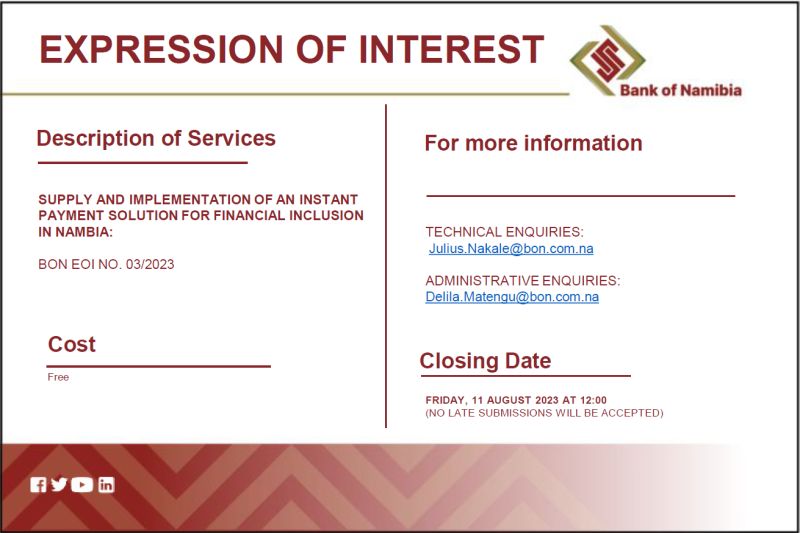
Bank of Namibia looking at instant payment solutions

The Bank of Namibia posted a call for expressions of interest for the supply and implementation of an instant payment solution for financial inclusion in Namibia (closing date August 11, 2023). [Read more on LinkedIn]

*For those interested in intra-day updates, check out my searchable Diigo Fintech developments database, which is also a good place to go to query for past developments: https://www.diigo.com/user/kiffmeister/ART.

Kiffmeister’s central bank digital currency monthly monitor

Just a reminder that I produce a monthly digest of central bank digital currency (CBDC) developments exclusively for the official sector. So (only) if you work at a central bank, ministry of finance or international financial institution (e.g., the BIS, IMF, OECD, World Bank) and who would like to receive it by email on the first business day of every month, please DM me on LinkedIn or email me at chronicles@kiffmeister.com.

The Sovereign Official Digital Association (SODA) is a technology-agnostic firm offering advisory services at the intersection of central banking, digital finance and the web3 industry, aiming to make public digital money a reality. SODA believes institutions in the existing financial ecosystem should have access to the tools and resources they need to move from discussion to action. SODA offers ‘real life’ use cases to help test digital money and drive adoption as central banks and other public institutions explore the future of a more financially inclusive world powered by interoperable blockchain-based networks. SODA would love you to join us on this journey – please get in touch (chris@sodapublicmoney.org).

Satoshi Capital Advisors is a New York-based, global advisory firm that works with central banks, governments, and the private sector to architect, implement, and operate varying initiatives. Satoshi Capital Advisors’ central bank work revolves around CBDC architecture and implementation, providing advisory services from research phase through to growth phase. Utilizing a product-market fit and technology agnostic approach to CBDC architecture and implementation enables Satoshi Capital Advisors to build tailored solutions, bespoke to local financial system nuances. Satoshi Capital Advisors welcomes requests from central bank officials for virtual and in-person CBDC workshops. [Click here for more information]

WhisperCash offers the first fully offline digital currency platform that has the same properties as physical cash. It can perform secure consecutive offline payments without compromising on security, privacy or accessibility. WhisperCash allows direct person to person offline payments without any server infrastructure or internet connectivity. It comes in various form factors including the self-contained credit card-sized “Pro” that sports an eInk screen and capacitive keyboard, and lasts for two weeks between recharges assuming a few transactions per day. [Click here for more information]

Kiffmeister’s #Fintech Daily Digest (20230805)*

European Central Bank FAQ on a digital euro

The ECB updated its digital euro FAQ with particular focus on the rationale for issuing a central bank digital currency (CBDC). “A digital euro would be an electronic form of cash for the digitalized world [that] would give consumers the option to use central bank money in a digital format… [and] providing… a digital means of payment universally accepted throughout the euro area…  Moreover, a digital euro would strengthen Europe’s strategic autonomy and monetary sovereignty by boosting the efficiency of the European payments’ ecosystem as a whole.” [Read more at the ECB]

The crypto cycle, equity markets, and US monetary policy

The IMF published a paper that analyzes the relationships between crypto prices and global equity markets and US monetary policy. It identifies a single price component it labels the “crypto factor” that explains 80% of variation in crypto prices, and shows that its increasing correlation with equity markets coincided with the entry of institutional investors into crypto markets. As for equities, US Fed tightening reduces the crypto factor through the risk-taking channel—in contrast to claims that crypto assets provide a hedge against market risk. [Read more at the IMF]


*For those interested in intra-day updates, check out my searchable Diigo Fintech developments database, which is also a good place to go to query for past developments: https://www.diigo.com/user/kiffmeister/ART.

Kiffmeister’s central bank digital currency monthly monitor

Just a reminder that I produce a monthly digest of central bank digital currency (CBDC) developments exclusively for the official sector. So (only) if you work at a central bank, ministry of finance or international financial institution (e.g., the BIS, IMF, OECD, World Bank) and who would like to receive it by email on the first business day of every month, please DM me on LinkedIn or email me at chronicles@kiffmeister.com.

The Sovereign Official Digital Association (SODA) is a technology-agnostic firm offering advisory services at the intersection of central banking, digital finance and the web3 industry, aiming to make public digital money a reality. SODA believes institutions in the existing financial ecosystem should have access to the tools and resources they need to move from discussion to action. SODA offers ‘real life’ use cases to help test digital money and drive adoption as central banks and other public institutions explore the future of a more financially inclusive world powered by interoperable blockchain-based networks. SODA would love you to join us on this journey – please get in touch (chris@sodapublicmoney.org).

Satoshi Capital Advisors is a New York-based, global advisory firm that works with central banks, governments, and the private sector to architect, implement, and operate varying initiatives. Satoshi Capital Advisors’ central bank work revolves around CBDC architecture and implementation, providing advisory services from research phase through to growth phase. Utilizing a product-market fit and technology agnostic approach to CBDC architecture and implementation enables Satoshi Capital Advisors to build tailored solutions, bespoke to local financial system nuances. Satoshi Capital Advisors welcomes requests from central bank officials for virtual and in-person CBDC workshops. [Click here for more information]

WhisperCash offers the first fully offline digital currency platform that has the same properties as physical cash. It can perform secure consecutive offline payments without compromising on security, privacy or accessibility. WhisperCash allows direct person to person offline payments without any server infrastructure or internet connectivity. It comes in various form factors including the self-contained credit card-sized “Pro” that sports an eInk screen and capacitive keyboard, and lasts for two weeks between recharges assuming a few transactions per day. [Click here for more information]

Kiffmeister’s #Fintech Daily Digest (20230804)*

MIT’s Project Hamilton open sources CBDC smart contract research

MIT’s Digital Currency Initiative (DCI) released the source code of its PArSEC (Parallelized Architecture for Scalably Executing smart Contracts) smart contract platform for central bank digital currency (CBDC). The work is part of the Boston Fed’s Project Hamilton and the open source code is publicly available on GitHub. PArSEC supports a wide class of smart contract runtimes, including the Ethereum Virtual Machine. It supports flexible research and testing: the system can support easy contract logic updating, or switching to different smart contract runtimes, without the need to understand and alter the core architecture of the underlying transaction processor. [Read more at the DCI]

Digital Dollar Project retail cross-border remittance payments

The Digital Dollar Project completed a proof-of-concept (PoC) with Western Union, BDO Unibank and Accenture that evaluated the potential benefits of using CBDC for cross-border remittances. The platform leveraged distributed ledger technology (DLT) to simulate the payments infrastructure necessary to transfer digital dollars to Philippine pesos. A decentralized exchange (DEX) provided a market for currency pair exchange to explore potential benefits associated with a decentralized marketplace to improve competition and price transparency. The PoC found that CBDCs may improve remittance processing by settling a peer-to- peer payment in less than ten seconds, a key driver being atomic settlement, which reduced counterparty risk and optimized liquidity via streamlined FX spot orders and multi-party settlement. [Read more at PR Newswire] 


*For those interested in intra-day updates, check out my searchable Diigo Fintech developments database, which is also a good place to go to query for past developments: https://www.diigo.com/user/kiffmeister/ART.

Kiffmeister’s central bank digital currency monthly monitor

Just a reminder that I produce a monthly digest of central bank digital currency (CBDC) developments exclusively for the official sector. So (only) if you work at a central bank, ministry of finance or international financial institution (e.g., the BIS, IMF, OECD, World Bank) and who would like to receive it by email on the first business day of every month, please DM me on LinkedIn or email me at chronicles@kiffmeister.com.

The Sovereign Official Digital Association (SODA) is a technology-agnostic firm offering advisory services at the intersection of central banking, digital finance and the web3 industry, aiming to make public digital money a reality. SODA believes institutions in the existing financial ecosystem should have access to the tools and resources they need to move from discussion to action. SODA offers ‘real life’ use cases to help test digital money and drive adoption as central banks and other public institutions explore the future of a more financially inclusive world powered by interoperable blockchain-based networks. SODA would love you to join us on this journey – please get in touch (chris@sodapublicmoney.org).

Satoshi Capital Advisors is a New York-based, global advisory firm that works with central banks, governments, and the private sector to architect, implement, and operate varying initiatives. Satoshi Capital Advisors’ central bank work revolves around CBDC architecture and implementation, providing advisory services from research phase through to growth phase. Utilizing a product-market fit and technology agnostic approach to CBDC architecture and implementation enables Satoshi Capital Advisors to build tailored solutions, bespoke to local financial system nuances. Satoshi Capital Advisors welcomes requests from central bank officials for virtual and in-person CBDC workshops. [Click here for more information]

WhisperCash offers the first fully offline digital currency platform that has the same properties as physical cash. It can perform secure consecutive offline payments without compromising on security, privacy or accessibility. WhisperCash allows direct person to person offline payments without any server infrastructure or internet connectivity. It comes in various form factors including the self-contained credit card-sized “Pro” that sports an eInk screen and capacitive keyboard, and lasts for two weeks between recharges assuming a few transactions per day. [Click here for more information]

Kiffmeister’s #Fintech Daily Digest (20230803)*

I’ve updated my tabulation of retail central bank digital currency (#CBDC) explorers. The changes are mostly minor, with some central banks shuffling up into the soon-to-pilot category. [See the update on my website]

Central bank digital currency technical guideline

The German Federal Office for Information Security (BSI) published a technical guideline (TR) describing requirements that ensure a high level of IT security for the backend systems that support the operation of a central bank digital currency (CBDC) ecosystem. If implemented, the CBDC ecosystem constitutes a critical infrastructure, and the TR aims to ensure that it is made resilient to a wide range of attacks. In addition to implementing the goal of security-by-design, this TR also considers some privacy aspects. [Read more at the BSI]

Towards acceptance criteria for a digital euro

An IU International University of Applied Sciences paper presented the results of a survey of 207 Germans regarding their attitudes towards a digital euro. The results suggest that a digital euro should be designed as a digital version of physical cash, and it should be well and seamlessly integrated into the existing landscape of banking applications. However, the potential benefits are not yet clear, especially regarding transparency and trustworthiness, and some respondents perceived little added value compared to bank accounts or cash. [Read more at EconStor]

Tel Aviv Stock Exchange to offer crypto services via Fireblocks pact

The Tel Aviv Stock Exchange (TASE) has signed an agreement with the digital asset platform Fireblocks to jointly offer a range of new digital asset products and services. The TASE noted that the new partnership will enable it to provide institutional-grade digital asset solutions for regulated entities. TASE had previously worked with Fireblocks and the Israeli Ministry of Finance on Project Eden, a proof-of-concept (PoC) that tested the atomic settlement of tokenized government bonds using digital payment tokens on a blockchain-based platform. [Read more at the TASE]


*For those interested in intra-day updates, check out my searchable Diigo Fintech developments database, which is also a good place to go to query for past developments: https://www.diigo.com/user/kiffmeister/ART.

Kiffmeister’s central bank digital currency monthly monitor

Just a reminder that I produce a monthly digest of central bank digital currency (CBDC) developments exclusively for the official sector. So (only) if you work at a central bank, ministry of finance or international financial institution (e.g., the BIS, IMF, OECD, World Bank) and who would like to receive it by email on the first business day of every month, please DM me on LinkedIn or email me at chronicles@kiffmeister.com.

The Sovereign Official Digital Association (SODA) is a technology-agnostic firm offering advisory services at the intersection of central banking, digital finance and the web3 industry, aiming to make public digital money a reality. SODA believes institutions in the existing financial ecosystem should have access to the tools and resources they need to move from discussion to action. SODA offers ‘real life’ use cases to help test digital money and drive adoption as central banks and other public institutions explore the future of a more financially inclusive world powered by interoperable blockchain-based networks. SODA would love you to join us on this journey – please get in touch (chris@sodapublicmoney.org).

Satoshi Capital Advisors is a New York-based, global advisory firm that works with central banks, governments, and the private sector to architect, implement, and operate varying initiatives. Satoshi Capital Advisors’ central bank work revolves around CBDC architecture and implementation, providing advisory services from research phase through to growth phase. Utilizing a product-market fit and technology agnostic approach to CBDC architecture and implementation enables Satoshi Capital Advisors to build tailored solutions, bespoke to local financial system nuances. Satoshi Capital Advisors welcomes requests from central bank officials for virtual and in-person CBDC workshops. [Click here for more information]

WhisperCash offers the first fully offline digital currency platform that has the same properties as physical cash. It can perform secure consecutive offline payments without compromising on security, privacy or accessibility. WhisperCash allows direct person to person offline payments without any server infrastructure or internet connectivity. It comes in various form factors including the self-contained credit card-sized “Pro” that sports an eInk screen and capacitive keyboard, and lasts for two weeks between recharges assuming a few transactions per day. [Click here for more information]

Kiffmeister’s #Fintech Daily Digest (20230802)*

Kenya suspends crypto project Worldcoin over safety concerns

Kenya’s interior ministry has suspended the local activities of the Worldcoin crypto-asset project while government agencies assess potential risks to public safety. The project launched on July 24, 2023. It requires users to give their iris scans in exchange for a digital ID, and in some countries users also get free crypto-assets as part of plans to create a new identity and financial network. France and Germany have also raised concerns around the legality of the biometric data collection and storage. [Read more at Reuters]

Global fintech funding falls to six-year low

According to CB Insights, global fintech funding hit its lowest level since 2017, totaling $7.8 billion in Q2 2023 (-48% from Q1 2023) through 845 rounds (-22%). The payments segment was hardest hit (-75% in funding terms), followed by digital lending (-44%). At the other end of the spectrum, fintech companies with artificial intelligence (AI)-led models (e.g., focused on digital lending, insurtech, and investment and capital market technology) saw strong funding growth according to data from S&P Global Market Intelligence. [Read more at CB Insights and S&P Global Market Intelligence]

Global fintech funding falls to $52.4 billion in H1 2023 

According to the latest KPMG Pulse of Fintech report H1 2023 was difficult for the fintech market globally, with both total funding and the number of deals dropping. There was increasing focus on operational efficiency, sustainable cash flows, and profitability. Crypto funding declined in the wake of sector challenges, combined with increasing focus on broader blockchain solutions. However, there is rapidly growing interest in potential use cases for generative AI, particularly in cybersecurity, insurtech, and wealthtech. [Read more at KPMG]


*For those interested in intra-day updates, check out my searchable Diigo Fintech developments database, which is also a good place to go to query for past developments: https://www.diigo.com/user/kiffmeister/ART.

Kiffmeister’s central bank digital currency monthly monitor

Just a reminder that I produce a monthly digest of central bank digital currency (CBDC) developments exclusively for the official sector. So (only) if you work at a central bank, ministry of finance or international financial institution (e.g., the BIS, IMF, OECD, World Bank) and who would like to receive it by email on the first business day of every month, please DM me on LinkedIn or email me at chronicles@kiffmeister.com.

The Sovereign Official Digital Association (SODA) is a technology-agnostic firm offering advisory services at the intersection of central banking, digital finance and the web3 industry, aiming to make public digital money a reality. SODA believes institutions in the existing financial ecosystem should have access to the tools and resources they need to move from discussion to action. SODA offers ‘real life’ use cases to help test digital money and drive adoption as central banks and other public institutions explore the future of a more financially inclusive world powered by interoperable blockchain-based networks. SODA would love you to join us on this journey – please get in touch (chris@sodapublicmoney.org).

Satoshi Capital Advisors is a New York-based, global advisory firm that works with central banks, governments, and the private sector to architect, implement, and operate varying initiatives. Satoshi Capital Advisors’ central bank work revolves around CBDC architecture and implementation, providing advisory services from research phase through to growth phase. Utilizing a product-market fit and technology agnostic approach to CBDC architecture and implementation enables Satoshi Capital Advisors to build tailored solutions, bespoke to local financial system nuances. Satoshi Capital Advisors welcomes requests from central bank officials for virtual and in-person CBDC workshops. [Click here for more information]

WhisperCash offers the first fully offline digital currency platform that has the same properties as physical cash. It can perform secure consecutive offline payments without compromising on security, privacy or accessibility. WhisperCash allows direct person to person offline payments without any server infrastructure or internet connectivity. It comes in various form factors including the self-contained credit card-sized “Pro” that sports an eInk screen and capacitive keyboard, and lasts for two weeks between recharges assuming a few transactions per day. [Click here for more information]

Kiffmeister’s #Fintech Daily Digest (20230801)*

DeFi liquidations: Volatility and liquidity

The OECD published a report that analyzes the connection between decentralized finance (DeFi) protocol liquidations and price volatility in decentralized exchanges (DEXs). The analysis employs transactional data of three of the largest DeFi lending protocols and suggests a positive relation between liquidations and post-liquidations price volatility across the main DEX pools. It also shows a positive correlation among borrowing rates and across different assets, which indicates that the liquidity in DeFi lending pools is connected, and that at extreme events, when investors pursue the same strategy at large numbers, liquidity of a particular asset may dry up in each of the pools across protocols. This implies that the liquidations mechanism might be limited in its ability to restore liquidity, as liquidators themselves rely on the liquidity available in the pools to repay underwater loans. [Read more at the OECD]

Ripple ruling rebuke complicates Coinbase’s defense against the SEC

In denying stablecoin issuer Terraform Labs’ motion to dismiss a U.S. Securities and Exchange Commission (SEC) lawsuit, Judge Jed Rakoff, of the U.S. District Court for the Southern District of New York rejected the use of a ruling from fellow Judge Analisa Torres, who recently ruled that Ripple Labs – another defendant against the SEC – did not violate securities law in making XRP available on secondary platforms for retail investors to purchase. Rakoff rejected Torres’ distinction between institutional sales and sales to retail investors on crypto exchanges, which he characterized as a misinterpretation of the Howey test used to determine if an asset is a security. [Read more at CoinDesk]

Namibia unveils new legal framework for digital asset providers

Namibia’s President Hage Geingob officially signed into law the Namibia Virtual Assets Act 2023 which covers the regulation of digital assets, cryptocurrencies and virtual asset service providers (VASPs) in the country. It establishes a framework for licensing and regulating VASPs, and appoints a regulatory authority responsible for supervising these providers and their activities. The Finance Ministry will determine the operative date for the law. [Read more on the Namibian government website]


*For those interested in intra-day updates, check out my searchable Diigo Fintech developments database, which is also a good place to go to query for past developments: https://www.diigo.com/user/kiffmeister/ART.

Kiffmeister’s central bank digital currency monthly monitor

Just a reminder that I produce a monthly digest of central bank digital currency (CBDC) developments exclusively for the official sector. So (only) if you work at a central bank, ministry of finance or international financial institution (e.g., the BIS, IMF, OECD, World Bank) and who would like to receive it by email on the first business day of every month, please DM me on LinkedIn or email me at chronicles@kiffmeister.com.

The Sovereign Official Digital Association (SODA) is a technology-agnostic firm offering advisory services at the intersection of central banking, digital finance and the web3 industry, aiming to make public digital money a reality. SODA believes institutions in the existing financial ecosystem should have access to the tools and resources they need to move from discussion to action. SODA offers ‘real life’ use cases to help test digital money and drive adoption as central banks and other public institutions explore the future of a more financially inclusive world powered by interoperable blockchain-based networks. SODA would love you to join us on this journey – please get in touch (chris@sodapublicmoney.org).

Satoshi Capital Advisors is a New York-based, global advisory firm that works with central banks, governments, and the private sector to architect, implement, and operate varying initiatives. Satoshi Capital Advisors’ central bank work revolves around CBDC architecture and implementation, providing advisory services from research phase through to growth phase. Utilizing a product-market fit and technology agnostic approach to CBDC architecture and implementation enables Satoshi Capital Advisors to build tailored solutions, bespoke to local financial system nuances. Satoshi Capital Advisors welcomes requests from central bank officials for virtual and in-person CBDC workshops. [Click here for more information]

WhisperCash offers the first fully offline digital currency platform that has the same properties as physical cash. It can perform secure consecutive offline payments without compromising on security, privacy or accessibility. WhisperCash allows direct person to person offline payments without any server infrastructure or internet connectivity. It comes in various form factors including the self-contained credit card-sized “Pro” that sports an eInk screen and capacitive keyboard, and lasts for two weeks between recharges assuming a few transactions per day. [Click here for more information]