Kiffmeister’s #Fintech Daily Digest (20260518)

RBA and DFCRC Release Findings From Project Acacia (RBA)

The Reserve Bank of Australia (RBA) and Digital Finance Cooperative Research Centre (DFCRC) published a report detailing the findings of Project Acacia, which examined how innovations in digital money and settlement infrastructure could support the development of wholesale tokenized asset markets in Australia. They tested 20 wholesale tokenized asset use cases across fixed income, repos, and managed funds. Atomic settlement, programmability, and composability benefits were demonstrated across asset classes, estimating A$24 billion in annual economic gains. Pilot wholesale central bank digital currency (CBDC) proved feasible on third-party distributed ledger technology (DLT) platforms but raised governance, finality, and liquidity fragmentation challenges. Real-time gross settlement (RTGS) synchronization mechanisms delivered comparable benefits at lower complexity. Deposit tokens are assessed as more suitable than stablecoins for wholesale settlement given prudential backing, though interbank transferability and deposit insurance scheme coverage require legislative clarification. They identified legal and regulatory uncertainty, coordination gaps, and interoperability as scaling barriers, motivating a post-Acacia program including a digital financial market infrastructure sandbox, expanded deposit token work, and RBA settlement infrastructure consultations. [RBA]

The University of Toronto Press published a book by lawyer and law professor Benjamin Geva on the evolution of money from barter to coins, banknotes, scriptural money, electronic money, and digital currencies. Of course, this has all been covered elsewhere, but what makes this book unique, is the deep, yet very readable, focus on legal aspects, particularly from the perspective of the Canadian monetary regime. The latter includes a thorough history going back to New France’s use of agricultural commodities and playing cards as money, to Bank of Canada explorations of both retail and wholesale central bank digital currencies (CBDCs). The book also extensively covers the legal aspects of virtual currencies, particularly stablecoins, and digital bearer instruments (DBIs). Interestingly, Geva makes a case for DBIs as the optimal Canadian retail CBDC as a path of least resistance through the Bank of Canada and Currency Acts, plus several architectural, economic, and privacy advantages over account-based platforms. He also singles out synthetic CBDCs as an optimal solution for achieving uniformity of money in a framework allowing competition. The book ends by addressing the challenges faced by the current monetary system as the digital age continues to evolve and become more decentralized. [To order the book, click here]

I am honored to have been given the opportunity to contribute a chapter to the soon-to-be released book, Tokenisation of Money: From Fiat Currencies to Stablecoins, published by Springer! Expertly edited by Prof. Selim Yazıcı, Prof. C. Coşkun Küçüközmen, and Dr. Michael Salmony, it serves as a critical handbook for navigating the profound transformation of the global financial services industry. At a time when there is substantial confusion regarding new digital instruments, this book distinguishes reality from hype across the dimensions of CBDCs, stablecoins, and tokenized deposits. In my contribution, I provide an overview and reality check on global retail central bank digital currency (CBDC) developments. The book will be available via digital platforms by the end of May and you can pre-order the hard cover version here: https://link.springer.com/book/9783032229458!

FYI I produce a monthly digest of digital fiat currency (DFC) developments exclusively for the official sector (e.g., central banks, ministries of finance and international financial institution (e.g., the BIS, IMF, OECD, World Bank)) plus academics and firms that are active in the DFC space (commercial banks, technology providers, consultants, etc.). (DFCs include central bank digital currency (CBDC), stablecoins and tokenized deposits.) It goes out via email on the first business day of every month, and if you’re interested in being on the mailing list, please email me at john@kiffmeister.com.

Kiffmeister’s #Fintech Daily Digest (20260517)

The Evolution and Future of Money in Canada (Benjamin Geva)

The University of Toronto Press published a book by lawyer and law professor Benjamin Geva on the evolution of money from barter to coins, banknotes, scriptural money, electronic money, and digital currencies. Of course, this has all been covered elsewhere, but what makes this book unique, is the deep, yet very readable, focus on legal aspects, particularly from the perspective of the Canadian monetary regime. The latter includes a thorough history going back to New France’s use of agricultural commodities and playing cards as money, to Bank of Canada explorations of both retail and wholesale central bank digital currencies (CBDCs). The book also extensively covers the legal aspects of virtual currencies, particularly stablecoins, and digital bearer instruments (DBIs). Interestingly, Geva makes a case for DBIs as the optimal Canadian retail CBDC as a path of least resistance through the Bank of Canada and Currency Acts, plus several architectural, economic, and privacy advantages over account-based platforms. He also singles out synthetic CBDCs as an optimal solution for achieving uniformity of money in a framework allowing competition. The book ends by addressing the challenges faced by the current monetary system as the digital age continues to evolve and become more decentralized. [To order the book, click here]

The Moneyness of Stablecoins (Odinet Tosado and Yadav)

In a forthcoming Yale Law Journal article, C. Odinet, A. Tosado and Y. Yadav develop a four-element legal framework for “moneyness” and apply it to stablecoins before and after the U.S. GENIUS Act. Moneyness requires conjunctive adequacy across the nature and substance of the claim, safety, discharge capacity, and negotiability, with deficiency in any element undermining the whole. The authors deconstruct the contractual and reserve structures of dominant issuers (Tether and Circle) to show that redemption is conditional and limited by privity, holders lack proprietary interests in backing reserves, and bankruptcy treatment remains ambiguous. These deficiencies matter because they force holders to assess both issuer and custodian solvency, undermine finality in payment discharge, and expose claimants to credit risk incompatible with money’s core function of circulating at par without investigation. The GENIUS Act of 2025 mandates reserve requirements and redemption frameworks but fails to resolve key vulnerabilities. It compels reliance on third-party custodians rather than Federal Reserve accounts, contains internally contradictory bankruptcy provisions, and provides no finality rules specifying when transfers extinguish obligations. The authors propose five targeted reforms; Federal Reserve master account access for qualifying issuers, industry-funded insurance, a secured interest regime replacing flawed bankruptcy rules, statutory finality provisions for both direct and intermediated transfers, and express tokenization of redemption rights. [Odinet Tosado and Yadav]

I am honored to have been given the opportunity to contribute a chapter to the soon-to-be released book, Tokenisation of Money: From Fiat Currencies to Stablecoins, published by Springer! Expertly edited by Prof. Selim Yazıcı, Prof. C. Coşkun Küçüközmen, and Dr. Michael Salmony, it serves as a critical handbook for navigating the profound transformation of the global financial services industry. At a time when there is substantial confusion regarding new digital instruments, this book distinguishes reality from hype across the dimensions of CBDCs, stablecoins, and tokenized deposits. In my contribution, I provide an overview and reality check on global retail central bank digital currency (CBDC) developments. The book will be available via digital platforms by the end of May and you can pre-order the hard cover version here: https://link.springer.com/book/9783032229458!

FYI I produce a monthly digest of digital fiat currency (DFC) developments exclusively for the official sector (e.g., central banks, ministries of finance and international financial institution (e.g., the BIS, IMF, OECD, World Bank)) plus academics and firms that are active in the DFC space (commercial banks, technology providers, consultants, etc.). (DFCs include central bank digital currency (CBDC), stablecoins and tokenized deposits.) It goes out via email on the first business day of every month, and if you’re interested in being on the mailing list, please email me at john@kiffmeister.com.

Kiffmeister’s #Fintech Daily Digest (20260513)

Stablecoin Remuneration and the U.S. Regulatory Framework

In this special edition of my daily digest I’ve prepared a summary of the issues around remunerated stablecoins in the U.S. regulatory context that started with the enactment of the GENIUS Act in July 2025, which prohibited stablecoin issuers from paying interest or yield to holders but is silent on whether affiliates or third-party platforms may offer equivalent rewards — a gap the crypto industry has moved quickly to exploit. The Office of the Comptroller of the Currency (OCC) February 2026 implementing rulemaking proposes to close this administratively by extending the prohibition to affiliates and related third parties, but that rule is not yet final. The CLARITY Act, the broader digital asset market structure bill that passed the House in July 2025 but is still making its way through the Senate, has become the primary legislative vehicle for resolving the question. The most recent draft has introduced a prohibition of yield on passive holdings while permitting activity-linked rewards, but it remains to be seen if this will get it through Senate Banking Committee and on to the Senate floor for a vote.

(Scroll down past this summary for some regularly scheduled central bank digital currency (CBDC) developments.)

The Banking Industry’s Case Against Stablecoin Remuneration

The banking industry’s core argument, advanced primarily by the American Bankers Association (ABA) and the Bank Policy Institute (BPI), is that yield-bearing stablecoins would erode bank deposits and, by extension, reduce the credit available to households and businesses (Nelson, 2026). The theoretical anchor is a family of general equilibrium models which show that a digital payment instrument offering yield can displace bank deposits and contract lending if its rate exceeds a certain threshold (Chiu et al., 2023). Research, funded by Coinbase, Paradigm, PayPal, and Stripe, adapted this framework to argue that current stablecoin reward levels fall within a “safe zone” that enhances rather than damages bank intermediation by forcing deposit repricing (Cong, 2026). Nelson (2026) turned the Cong (2026) model against itself, the paper implies that once stablecoins reach projected 2030 scale, dollar-for-dollar deposit destruction and significant lending contraction follows. Wang (2025) estimates that such lending contraction could be between $65 billion and $1.26 trillion depending on adoption scale, reserve management, and whether issuers gain Federal Reserve master account access.

However, two caveats are warranted:

  • The Chiu et al. (2023) framework was designed to model a central bank digital currency — a sovereign instrument set by a welfare-maximizing authority with a single rate and a financial stability mandate. Transposing it to a competitive stablecoin market, where multiple private issuers face profit incentives and no coordination mechanism, important assumptions that do not hold. The central bank in that framework can target the “sweet spot” of beneficial competition precisely because it internalizes systemic consequences; a private stablecoin issuer — or more precisely, the exchange intermediaries passing reserve income through to holders via subscription models and loyalty programs — faces no equivalent constraint.
  • Wang (2025) does not model whether competitive deposit repricing could generate the crowding-in effect that Chiu et al. (2023) identify — i.e., whether banks raising deposit rates in response to stablecoin competition might expand intermediation sufficiently to offset or reverse the deposit migration. She treats the competitive response as a defensive mechanism that partially cushions outflows, not as a mechanism that could produce a welfare-enhancing equilibrium. The paper’s analytical architecture simply takes deposit outflows as directionally given and then traces their consequences for credit provision, without closing the loop through endogenous bank pricing behavior.

Nelson (2026)’s strongest argument points to the Coste (2024) analysis, which shows that even when stablecoin reserves remain within the banking system as deposits, they arrive as wholesale funding subject to 100% liquidity coverage ratio (LCR) outflow rates rather than the 5–10% applicable to retail deposits. The receiving bank must therefore hold equivalent high-quality liquid assets against them, rendering those funds prudentially inert for lending purposes. This mechanism operates regardless of whether aggregate deposit volumes change, and it is mechanical rather than behavioral — meaning it holds even if banks reprice deposits competitively in response to stablecoin competition.

The Affiliate Loophole and Section 404 of the CLARITY Act

Section 404 of the current CLARITY Act draft (“prohibiting interest and yield on payment stablecoins”) reaffirms the GENIUS Act’s core prohibition on issuer-paid yield and attempts to resolve the affiliate loophole question that it left open. It draws a distinction between rewards linked to transaction activity (e.g., paying a stablecoin to a merchant, completing a cross-border transfer) and rewards accruing solely from holding a balance in a digital wallet. The former would be permitted; the latter prohibited. In practice, this mirrors the legal recharacterization already underway in the market, such as Coinbase’s move to restrict USDC rewards to Coinbase One subscribers and its framing of those rewards as a “loyalty program” rather than passive yield. This is the kind of arrangement the most recent draft attempts to legitimize for activity-linked payments while drawing a line against pure balance-based accrual. Whether that line is administratively enforceable, given that the economic substance of near-term Treasury yield pass-through does not change based on how the payment is labelled, remains the central unresolved question.

The Challenge of Fintech Cash Management Products

An analytical tension in the banking industry’s position is revealed by its treatment of fintech cash management products. Platforms such as Betterment currently pay depositors approximately 3.25% annually — close to the federal funds rate — by sweeping customer funds across a network of Federal Deposit Insurance Corporation (FDIC)-insured banks. This model does to branch-based banks’ deposit spreads essentially what the Chiu et al. (2023) mechanism predicts a competitive outside option should do: it forces repricing. Yet when the FDIC proposed in 2024 to tighten the brokered deposit rules that govern these arrangements, which would have subjected fintech sweep products to additional restrictions, the ABA, BPI, and a coalition of nine other trade groups jointly opposed the proposal.

The explanation likely lies in the structure of the banking lobby’s membership. Large banks that anchor sweep networks and receive wholesale deposits via them have no interest in restricting arrangements that benefit their funding base. The stablecoin case is structurally different — reserves held in Treasury bills or at the Federal Reserve bypass the banking system entirely — which is why it generates a unified banking industry response. The banking lobby’s argument implicitly treats the current level of deposit spreads as socially optimal and worth protecting, while simultaneously defending the very competitive mechanisms that have already eroded those spreads for rate-sensitive depositors.

Unresolved Tensions

Several questions remain open regardless of how the drafting process resolves. The activity-versus-passive-holding distinction in Section 404 rests on a legal characterization that may not be administratively stable. If the economic pass-through of reserve income to holders is empirically indistinguishable between the two forms — Krause (2026) found a 98.7% correlation between USDC rewards and Treasury yields — enforcement of the distinction will depend on definitional precision that neither the current legislative text nor the OCC rulemaking has yet provided. The Coste (2024) LCR mechanics apply irrespective of how the yield question is resolved, suggesting that prudential concerns about deposit composition persist even under a complete yield prohibition. The Wang (2025) finding that effects are highly heterogeneous across bank types — with mid-sized regional banks facing the greatest vulnerability — points to a distributional dimension that aggregate models obscure and that community banking advocates have raised without yet quantifying rigorously at the institutional level. Finally, the broader question of whether branch-based deposit spreads reflect productive intermediation or market power against inertial depositors remains analytically unresolved in the policy debate (Zhang et al., 2024). The answer to that question matters considerably for evaluating how much of the banking industry’s concern reflects genuine systemic risk versus incumbent rent protection.

Now on to the regularly scheduled updates…

Digital Shekel Project: Progress Report 2025 (Bank of Israel)

The Bank of Israel published an update on its digital shekel project that is progressing toward an end‑2026 issuance decision, concluding that expected macroeconomic benefits are likely to exceed the associated costs. The analysis found that disintermediation risk is low under appropriately calibrated holding limits, with policy rate cuts and liquidity injections (via short‑term Bank of Israel bill redemptions) sufficient to offset deposit outflows except under extreme scenarios. A decentralized supervisory model is proposed, with existing financial regulators overseeing their respective digital shekel participants under a uniform Bank of Israel rulebook. A unified multipurpose infrastructure for retail and wholesale use is found technologically feasible and preferable to separate systems. Open questions include whether the digital shekel should be remunerated, offline payment double‑spend prevention, and retail‑versus‑wholesale sequencing. In addition, a quantitative survey of small businesses found that only one‑fifth expressed interest in using digital shekels, citing satisfaction with existing digital payment methods, although they indicated general interest in a digital shekel if it were to offer lower fees than current digital payment methods. A qualitative survey of large corporations also found lukewarm interest in using a digital shekel, with respondents mainly viewing it as potentially relevant for internal settlement and treasury operations rather than for customer‑facing retail payments, and stressing the importance of compatibility with existing systems. [Bank of Israel]

BOE DLT Innovation Challenge 2025: Final Report (BOE)

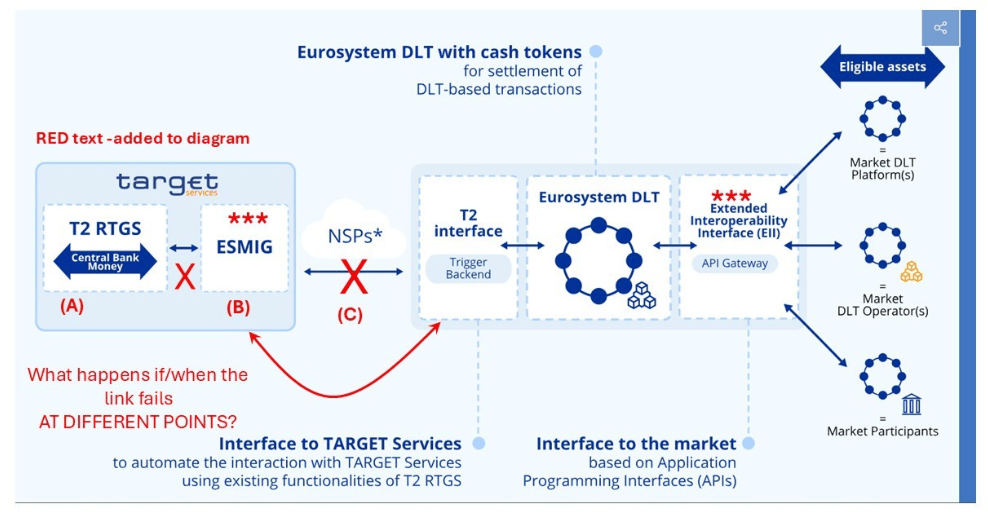
The Bank of England (BOE) reported on explorations, carried out in September–October 2025 with nine firms, to see if wholesale central bank money can be transacted and settled on an external programmable ledger not controlled by the central bank. It concluded that distributed ledger technology (DLT) can technically speed wholesale settlement and improve throughput but only by accepting material trade‑offs in finality, governance, and resilience. Designs that deliver faster, more “deterministic” settlement tend to shift risk and trust assumptions, weakening decentralization or operational robustness relative to established real‑time gross settlement systems. Scalability enhancements add architectural complexity and create new dependencies that interact negatively with control and resilience requirements. Interoperability solutions with other DLT and legacy systems rarely eliminate trust or operational dependencies; instead they reallocate them across networks or third parties, including off‑chain components for permissionless ledgers. Overall, the trials suggest no dominant DLT architecture for wholesale settlement and frame the policy problem as one of choosing which trade‑offs in speed, control, and governance are acceptable. Further targeted DLT experiments are planned for 2026. [BOE]

Kiffmeister’s #Fintech Daily Digest (20260508)

To Tokenize, or Not to Tokenize: The Design Question for a CBDC (Bank of Canada)

The Bank of Canada published a paper that develops a general equilibrium model to assess whether a central bank digital currency (CBDC) should be tokenized—deployable on programmable ledgers to compete with stablecoins—or non-tokenized and confined to off-chain markets, where traditional and crypto banks coexist. Tokenization matters for equilibrium only when collateral use differs across sectors; the three governing structural parameters are crypto-bank pledgeability, crypto-asset scarcity, and the social valuation of on-chain transactions. For institutional design, tokenized CBDC crowds out stablecoins and improves welfare when crypto banks are unreliable and crypto collateral is scarce, whereas non-tokenized CBDC may dominate when on-chain activity is less socially desirable or bond-collateral reallocation to the crypto sector is itself welfare-improving; both forms reduce bank lending, posing a payment-efficiency-versus-intermediation trade-off. [Bank of Canada]

Patterns and Determinants of Global Cryptocurrency Flows (Bank of Canada)

The Bank of Canada published a paper that uses Chainalysis on-chain data for up to 162 countries (2020–2023) to document cross-border Bitcoin flow patterns, identify their determinants, and extend the analysis to four major stablecoins. Bitcoin flows behave distinctly from traditional capital flows in level and volatility, with net outflows concentrated in emerging market economies and net inflows in advanced economies. Panel analysis identifies seven motives—adverse current and past macro and financial conditions, weak institutions, underdeveloped financial systems, payments and remittances demand, capital control circumvention, and sanctions evasion—of which macro conditions and remittances are most robust; a COVID-19 difference-in-differences exercise corroborates both. The remittances finding suggests cryptocurrency fills gaps in cross-border payment infrastructure, while evidence of capital control and sanctions circumvention supports closer regulatory oversight; the Chainalysis country-attribution methodology, which relies on web traffic as a proxy for user location, remains an unresolved data limitation. [Bank of Canada]

I am honored to have been given the opportunity to contribute a chapter to the soon-to-be released book, Tokenisation of Money: From Fiat Currencies to Stablecoins, published by Springer! Expertly edited by Prof. Selim Yazıcı, Prof. C. Coşkun Küçüközmen, and Dr. Michael Salmony, it serves as a critical handbook for navigating the profound transformation of the global financial services industry. At a time when there is substantial confusion regarding new digital instruments, this book distinguishes reality from hype across the dimensions of CBDCs, stablecoins, and tokenized deposits. In my contribution, I provide an overview and reality check on global retail central bank digital currency (CBDC) developments. The book will be available via digital platforms by the end of May and you can pre-order the hard cover version here: https://link.springer.com/book/9783032229458!

FYI I produce a monthly digest of digital fiat currency (DFC) developments exclusively for the official sector (e.g., central banks, ministries of finance and international financial institution (e.g., the BIS, IMF, OECD, World Bank)) plus academics and firms that are active in the DFC space (commercial banks, technology providers, consultants, etc.). (DFCs include central bank digital currency (CBDC), stablecoins and tokenized deposits.) It goes out via email on the first business day of every month, and if you’re interested in being on the mailing list, please email me at john@kiffmeister.com.
Kiffmeister’s #Fintech Daily Digest (20260505)

Legal Tender -A Barbarous Relic in the Digital Currency Era (SSRN)

In a paper posted on SSRN, Christian Pfister argues that granting legal tender status to retail central bank digital currency (CBDC) in advanced economies is a conceptually weak and potentially distortionary extension of a historically contingent, often obsolete institution. The paper critiques recent IMF legal analyses for presuming a “digital cash” equivalence and for conflating the unit of account, the issuer, and specific payment instruments when defining legal tender. Pfister shows that modern payment efficiency, financial inclusion, and safety can be achieved through regulation and public infrastructure without legal tender, and that combining legal tender status with regulated aggressive pricing of public rails could crowd out deposits, weaken bank intermediation, and recreate public “walled gardens.” This raises a core design question: whether any residual role for legal tender should attach to the unit of account, central bank liabilities, or particular instruments, and how to do so without impairing monetary transmission, competition, or innovation. [SSRN]

Digital Money and the Architecture of Trust (Banca d’Italia)

Chiara Scotti, Deputy Governor of Banca d’Italia, argues that debates on central bank digital currencies (CBDCs), stablecoins and tokenized deposits must shift from instruments to system architecture, with trust and “singleness of money” anchored in central bank money and regulatory design. She proposes a seven‑dimensional framework (efficiency, trust/convertibility, stability, market functioning, intermediation, transmission, regulation) focused on bearer versus non‑bearer design, settlement inside or outside the central bank core, and reserve structures. This framing highlights unresolved questions about how tokenized private monies reshape monetary policy transmission, safe‑asset demand and bank funding, and whether European tokenization should extend existing infrastructures such as the Single Euro Payments Area rather than rely on new private rails. [Banca d’Italia]

Progressing Fund Tokenisation (UK FCA)

The UK Financial Conduct Authority (UK FCA)sets out final rules and guidance to accelerate tokenisation of authorised funds and introduce an optional “direct to fund” dealing model using issues-and-cancellations accounts instead of manager box dealing. The statement clarifies that on-chain ledgers can be primary books and records, public distributed ledgers and smart contracts are permitted subject to outcome‑based controls, and tokenised units may sit across multiple blockchains within a class. It tightens ring‑fencing around umbrella cash by constraining omnibus issue-and-cancellation accounts under protected cell legislation, while dropping a proposed mandatory client‑money fallback and instead imposing enhanced reconciliation and unattributed‑cash rules. The package signals openness to stablecoins and tokenised gilts for settlement and operations under an interim waiver‑based regime, while deferring full alignment with the new crypto-asset framework and future composable “tokenised portfolio management” models. [UK FCA]

The BCEAO Invites Submissions for Research on Financial Inclusion (BCEAO)

The Central Bank of West African States (BCEAO) is inviting submissions for the 2026 Abdoulaye FADIGA Prize, which rewards high‑quality economic research on West African Economic and Monetary Union (WAEMU) economies. It explicitly invites research on financial inclusion and digital innovation, including work on how cryptocurrencies, mobile money, central bank digital currencies, and fintech can expand access to financial services in WAEMU, while rigorously assessing associated risks, regulatory and supervisory implications, and their interaction with payment systems, financial stability, and monetary policy transmission in the Union. [BCEAO]

I am honored to have been given the opportunity to contribute a chapter to the soon-to-be released book, Tokenisation of Money: From Fiat Currencies to Stablecoins, published by Springer! Expertly edited by Prof. Selim Yazıcı, Prof. C. Coşkun Küçüközmen, and Dr. Michael Salmony, it serves as a critical handbook for navigating the profound transformation of the global financial services industry. At a time when there is substantial confusion regarding new digital instruments, this book distinguishes reality from hype across the dimensions of CBDCs, stablecoins, and tokenized deposits. In my contribution, I provide an overview and reality check on global retail central bank digital currency (CBDC) developments. The book will be available via digital platforms by the end of May and you can pre-order the hard cover version here: https://link.springer.com/book/9783032229458!

FYI I produce a monthly digest of digital fiat currency (DFC) developments exclusively for the official sector (e.g., central banks, ministries of finance and international financial institution (e.g., the BIS, IMF, OECD, World Bank)) plus academics and firms that are active in the DFC space (commercial banks, technology providers, consultants, etc.). (DFCs include central bank digital currency (CBDC), stablecoins and tokenized deposits.) It goes out via email on the first business day of every month, and if you’re interested in being on the mailing list, please email me at john@kiffmeister.com.

Kiffmeister’s #Fintech Daily Digest (20260504)

I am honored to announce that I have contributed a chapter to the soon-to-be released book, Tokenisation of Money: From Fiat Currencies to Stablecoins, published by Springer! Expertly edited by Prof. Selim Yazıcı, Prof. C. Coşkun Küçüközmen, and Dr. Michael Salmony, it serves as a critical handbook for navigating the profound transformation of the global financial services industry. At a time when there is substantial confusion regarding new digital instruments, this book distinguishes reality from hype across the dimensions of CBDCs, stablecoins, and tokenized deposits. In my contribution, I provide an overview and reality check on global retail central bank digital currency (CBDC) developments. The book will be available via digital platforms by the end of May and you can pre-order the hard cover version here: https://link.springer.com/book/9783032229458!

FYI I produce a monthly digest of digital fiat currency (DFC) developments exclusively for the official sector (e.g., central banks, ministries of finance and international financial institution (e.g., the BIS, IMF, OECD, World Bank)) plus academics and firms that are active in the DFC space (commercial banks, technology providers, consultants, etc.). (DFCs include central bank digital currency (CBDC), stablecoins and tokenized deposits.) It goes out via email on the first business day of every month, and if you’re interested in being on the mailing list, please email me at john@kiffmeister.com.

Kiffmeister’s #Fintech Daily Digest (20260502)

BOE Considers Keeping Digital Pound On Ice as Rivals Race Ahead (Bloomberg)

The Bank of England (BOE) and HM Treasury (HMT) are reportedly considering slowing down the digital pound project to defer making an immediate firm decision to approve or scrap it. Officials have been encouraged by private-sector innovation—especially tokenized deposits—that could deliver many CBDC benefits (faster, cheaper payments) within the existing regulated banking system, reducing the urgency to build a central-bank solution. The project has faced skepticism from the public, Parliament, and even BOE Governor Andrew Bailey, who remains unconvinced of the need for a retail CBDC. A decision to build would entail upfront costs in the hundreds of millions of pounds (albeit later offset by CBDC income), voluntary participation by banks, and risk of political backlash over privacy concerns. [Bloomberg]

Meta Rolls Out Stablecoin Payments (Coindesk)

Meta rolled out digital currency payouts for select creators in Colombia and the Philippines. The payouts use the USDC stablecoin on either the Solana or Polygon blockchain networks, processed via Stripe’s Link wallet and accompanied by tax reporting from both Meta and Stripe. The initiative marks Meta’s return to stablecoins after it attempted to introduce the Libra token, later renamed Diem, only to shut down the project amid regulatory scrutiny in 2022. [Meta]

Central Bank Digital Currency and Monetary Architecture (Dirk Niepelt)

In a literature review that has been accepted for publication by the Journal of Economic Literature, Dirk Niepelt argues that the macroeconomic consequences of retail central bank digital currency (CBDC) depend primarily on the policy choices accompanying its introduction. Organizing the survey around a neutrality result, the paper demonstrates that bank disintermediation does not independently constitute a source of non-neutrality, provided the central bank recycles CBDC proceeds to banks on deposit-equivalent terms. Most existing research conflates policy-contingent with fundamental sources of non-neutrality, obscuring the extent of policymaker control. Because CBDC represents a structural shift in monetary architecture rather than a technical payment upgrade, it raises political economy questions that exceed the conventional mandate of central banks. [Niepelt.ch]

On the Resilience of Payment Methods (NBER)

The U.S. National Bureau of Economic Research (NBER) published a paper that argues, using multi-source U.S. and cross-country evidence, that cash functions as critical fallback liquidity when electricity outages disable digital payment infrastructure during natural disasters. Event studies across store-level transaction data, card aggregates, and household scanner records show that hurricanes generate persistent outages, shifting spending composition sharply toward cash, while pre-disaster expenditure spikes are credit-financed stockpiling. The finding that payment-system fragility is a first-order attribute of any instrument has direct implications for regulators overseeing cashless transitions, mandatory acceptance rules, and the design of offline-capable central bank digital currencies. [NBER]

FYI I produce a monthly digest of digital fiat currency (DFC) developments exclusively for the official sector (e.g., central banks, ministries of finance and international financial institution (e.g., the BIS, IMF, OECD, World Bank)) plus academics and firms that are active in the DFC space (commercial banks, technology providers, consultants, etc.). (DFCs include central bank digital currency (CBDC), stablecoins and tokenized deposits.) It goes out via email on the first business day of every month, and if you’re interested in being on the mailing list, please email me at john@kiffmeister.com.

Kiffmeister’s #Fintech Daily Digest (20260430)

Crypto-Asset Service Providers as Financial Intermediaries: Risks and Policy Approaches (BIS)

The Bank for International Settlements (BIS) published a paper that argues that large crypto-asset service providers have evolved into multifunction crypto-asset intermediaries performing bank-like risk transformation and should face commensurate prudential regulation. The paper documents expansion from custody and trading into lending, derivatives, and “earn” programs that transform client assets into credit, liquidity, and maturity risks. Such activities replicate core intermediation functions without capital, liquidity, or supervisory safeguards, raising financial-stability and regulatory-perimeter concerns as links to traditional finance deepen. The authors advocate a combined entity- and activity-based approach, while noting unresolved issues around data gaps, cross-border supervision, and incomplete coverage of key activities. [BIS]

The Stablecoin Stumbling Block (FT)

The Financial Times published a paper in which Daniel Heller argues that existing stablecoin designs are structurally unfit to serve as wholesale settlement assets at scale. He notes that post-crisis standards for financial market infrastructures require settlement in central bank money or assets with equivalent credit quality and intraday liquidity, a bar current stablecoin reserve and redemption models fail to meet. This matters because large-value payments and securities settlement depend on systemically robust “money,” and today’s stablecoins embed maturity, liquidity, and operational risks misaligned with that role. Heller sees potential in tokenized central bank money or purpose-built, narrow-balance-sheet wholesale stablecoins, but leaves open whether central banks will grant reserve access and how global oversight would be structured. [FT]

I’m reposting this paper by Christian Pfister because of its relevance to yesterday’s post regarding the European Central Bank’s (ECB’s) stated digital euro motivations:

For a Political Economy of Central Bank Digital Currency (REP)

In this 2024 Revue d’Economie Politique (REP) article, Christian Pfister applies a positive (political economy) rather than normative framework to retail central bank digital currency (rCBDC). He maps stakeholder incentives across governments, central banks, regulators, incumbent banks, and fintech firms, then tests whether stated policy rationales align with those incentives. He concludes that publicly foregrounded motives, like financial inclusion, payment system safety, monetary sovereignty, and privacy, are analytically weak or already reached in developed economies. The dominant but largely unstated drivers are fiscal, such as seigniorage maximization through balance-sheet expansion, permanent rollover of sovereign debt held as rCBDC backing, and reduced tax evasion. Setting rCBDC remuneration at zero, officially framed as “do no harm” to bank intermediation, simultaneously serves those seigniorage objectives while suppressing a monetary policy transmission channel that the academic literature broadly endorses. For institutional design, combining legal tender status with fee exemptions advantages rCBDC in ways that raise competitive-neutrality concerns and risk crowding out private innovation. In non-democratic settings, programmable money creates structural conditions for mass surveillance. [REP]

And some backfilling (this one formalizes what most of us have known for about a year…)

Eastern Caribbean Central Bank (ECCB) Suspends DCash 2.0 Project (ECCB)

[February 13, 2026] The Monetary Council of the Eastern Caribbean Central Bank (ECCB) approved the suspension of the DCash 2.0 central bank digital currency (CBDC) project to prioritize the development of the fast payment system (FPS) and participation in the The Caribbean Community (CARICOM) Payments and Settlement System (CAPSS) pilot. [ECCB]

FYI I produce a monthly digest of digital fiat currency (DFC) developments exclusively for the official sector (e.g., central banks, ministries of finance and international financial institution (e.g., the BIS, IMF, OECD, World Bank)) plus academics and firms that are active in the DFC space (commercial banks, technology providers, consultants, etc.). (DFCs include central bank digital currency (CBDC), stablecoins and tokenized deposits.) It goes out via email on the first business day of every month, and if you’re interested in being on the mailing list, please email me at john@kiffmeister.com.

Kiffmeister’s #Fintech Daily Digest (20260429)

Selling the Digital Euro to Legislators (PIIE)

On April 22, 2026, the Peterson Institute for International Economics (PIIE) hosted a virtual event at which Nicolas Véron interviewed the European Central Bank’s (ECB’s) Piero Cipollone on the digital euro project. As Izabella Kaminska noted on X, at one point Veron opined that the ECB’s concerns about the big US payment companies (e.g., MasterCard and VISA) pulling out of Europe is somewhat far-fetched, to which Cipollone admitted that the rhetoric is largely in play just to motivate legislators to push ahead with the digital euro. “The geopolitical risk, this is resonating much more with politicians and that’s where we saw some acceleration from the political side to put this project into focus… I must confess that before, this was a slow-moving project, at least at the legislative level. Then what happened in the last three/four years, it provided a sort of acceleration, mostly on the political side”. [PIIE]

Digitalization and Innovation – Opportunities and Risks for Financial Health (BIS)

A Bank for International Settlements (BIS) Financial Stability Institute brief argues that digital financial innovation is enhancing access to payments, credit, savings and insurance, and can help people to manage their financial obligations and have greater confidence in their financial future. However, these benefits are emerging alongside new vulnerabilities: a global surge in scams and fraud, greater overindebtedness among some digital borrowers and the use of ill-suited investment products. This mixed record challenges the presumption that inclusion automatically produces well-being, requiring supervisors to adopt outcome-focused oversight and disaggregated measurement beyond access metrics alone. Whether digital public infrastructure can systematically translate inclusion gains into durable financial health improvements at scale remains empirically unresolved. [BIS]

FYI I produce a monthly digest of digital fiat currency (DFC) developments exclusively for the official sector (e.g., central banks, ministries of finance and international financial institution (e.g., the BIS, IMF, OECD, World Bank)) plus academics and firms that are active in the DFC space (commercial banks, technology providers, consultants, etc.). (DFCs include central bank digital currency (CBDC), stablecoins and tokenized deposits.) It goes out via email on the first business day of every month, and if you’re interested in being on the mailing list, please email me at john@kiffmeister.com.