Kiffmeister’s #Fintech Daily Digest (20220603)

Japan Passes Stablecoin Bill That Enshrines Investor Protection

Japan’s parliament passed a bill that classifies stablecoins as digital money that must be linked to a currency that is legal tender and guarantee holders the right to redeem them at face value. The legal definition means stablecoins can only be issued by licensed banks, registered money transfer agents and trust companies. The new legal framework will take effect in a year, and Japan’s Financial Services Agency will introduce regulations governing stablecoin issuers in coming months. [Read more]

Central African Republic announces plan to tokenize country’s minerals

The Central African Republic (CAR) announced plans to offer tokenized access to mineral resources to crypto and digital asset projects that establish a presence in the country. The natural resource tokenization drive will come under the auspices of Project Sango. In addition to petroleum, CAR possesses cobalt, copper, diamonds, gold, limestone, manganese and rhodium. [Read more]

Upcoming events I’m affiliated with:

The CBDC Think Tank is hosting a CBDC Papers Lecture Series on June 17 and 24 starting at 7am EST and running for 4 hours each day. [View list of papers and register here]

Kiffmeister’s #Fintech Daily Digest (20220601)

Managing the failure of systemic digital settlement asset (including stablecoin) firms

The U.K. government proposes to amend its Financial Market Infrastructure Special Administration Regime to bring crypto-assets within the jurisdiction of the Bank of England while giving the institution the reins in the event of a collapsing stablecoin. One proposed amendment includes broadening the legal definition of a “payment system” to include crypto-assets, providing the central bank with regulatory powers under Part 5 of the 2009 Banking Act. The government clarified that the central bank will only step in during “systemic” collapses, which it defines as any “deficiencies in [a system’s] design or disruption to its operation may threaten the stability of the U.K. financial system or have significant consequences for businesses or other interests.” [Read more]

MAS Partners the Industry to Pilot Use Cases in Digital Assets

The Monetary Authority of Singapore (MAS) announced the commencement of Project Guardian, a collaborative initiative with the financial industry that seeks to explore asset tokenization use cases. The central bank will run pilot tests in four areas to test the feasibility of applications covering blockchain, trust anchors, asset tokenization and institutional-grade decentralized finance (DeFi) protocols. The first industry pilot will explore potential DeFi applications in wholesale funding markets, involving the creation of a permissioned liquidity pool comprising tokenized bonds and deposits. The pilot aims to carry out secured borrowing and lending on a public blockchain-based network through execution of smart contracts. [Read more]

Bank of Ghana tests CBDC integration with mobile money providers

The Central Bank of Ghana (BoG) has reportedly granted Vodafone Cash and CalBank customers the opportunity to test its online version of its central bank digital currency (CBDC), the eCedi. BoG has created online and offline wallets for eCedi but has only deployed the online pilot in the city’s capital, Accra, and Tarkwa. Meanwhile, the BoG’s Governor reported that usage and uptake of the offline version of the eCedi is still being piloted in a small town called Sefwi Asafo in the Western North region. [Read more]

Retail CBDC and U.S. Monetary Policy Implementation: A Stylized Balance Sheet Analysis

A Federal Reserve paper explores how a retail central bank digital currency (CBDC) could affect the balance sheets of the Federal Reserve, commercial banks, and U.S. households. Then it considers how these balance sheet changes could affect monetary policy implementation. It illustrates that the potential effects are highly dependent on the initial conditions of the Fed’s balance sheet. It considers a scenario where the digital dollar were to be widely adopted for both payments and a store of value, in which case the Fed would need to hold more Treasuries on a permanently bigger balance sheet. Moreover, the analysis demonstrates how the Fed may use its existing tools to manage the effects of a retail CBDC on monetary policy implementation. [Read more]

Legal Wrappers and DAOs

This paper co-authored by Chris Brummer offers an overview and explanation of legal wrappers available to decentralized autonomous organizations (DAOs) in a U.S. legal context. It observes how the qualitative features of DAOs are unanticipated by legal wrappers modeled after 20th century corporations, nonprofits and partnerships. It then surveys a diverse range of wrappers available to DAOs, and highlights how thoughtful legal engineering can help mitigate frictions that arise when attempting to wrap established legal forms around DAOs and DAO operations. To demonstrate, the white paper proceeds through a variety of fact scenarios spanning protocol, media, collector, social, and philanthropic DAOs to illustrate how wrappers might be employed to protect DAO participants from unlimited liability, optimize tax treatment, engage in contractual off-chain transactions, and enable compliance with key regulatory expectations. [Read more]

Upcoming events I’m affiliated with:

The CBDC Think Tank is hosting a CBDC Papers Lecture Series on June 17 and 24 starting at 7am EST and running for 4 hours each day. [View list of papers and register here]

Kiffmeister’s #Fintech Daily Digest (20220509)

UST Stablecoin Falls Below Dollar Peg for Second Time in 48 Hours

TerraUSD (UST), the the third largest stablecoin by market capitalization and the largest algorithmic stablecoin, has lost its dollar peg. The first depeg took place on May 7 (Saturday) and after recovering the next day, the peg broke again today (Monday, May 9). This isn’t UST’s first depeg, nor its largest, but it marks the first time it has lost its peg since it started building out Bitcoin and Avalanche reserves. Today’s depeg comes after the Luna Foundation Guard announced Sunday night that $1.5 billion of its massive bitcoin reserves would be “loaned” out to professional market makers to proactively defend UST’s dollar peg. [Read more]

Bank of Israel still unsure on digital shekel but garners public support

The Bank of Israel has received public support for its plans to possibly issue a digital shekel on grounds it would help the economy by supporting innovation in the payments system, reducing the amount of cash and bolstering the fintech sector. Although the central bank has not made a final decision on whether it will issue a digital shekel, all of the responses to the public consultation indicate support for continued research regarding the various implications on the payments market, financial and monetary stability, legal and technological issues, and more. Some want full anonymity like cash, while others believe a digital shekel should be subject to money laundering rules and helping the war on the “black economy.” Also, a digital shekel should also come at a zero or low costs to business owners and consumers and be easy to use for all, including the elderly. [Read more]

The Bahamas’ Sand Dollar Needs Improved Cybersecurity, IMF Says

The International Monetary Fund (IMF) said that the Bahamas’ Sand Dollar central bank digital currency (CBDC) needs better reach and more security to achieve its aims. The IMF noted the Sand Dollar represents only 0.1% of currency in circulation. The country’s central bank “should continue strengthening internal capacity – including on cybersecurity and the resilience of systems associated with the Sand Dollar,” adding that there are currently “limited avenues to use the Sand Dollar.” [Read more]

Indian central securities depository to back up its monitoring of bonds by blockchain

The National Securities Depository (NSDL), India’s central securities depository, launched a blockchain-based security and covenant monitoring platform. The platform is expected to strengthen the monitoring of security and governance in the corporate bonds market to bring “further discipline and transparency to the market.” The network will be maintained by two nodes, whom the NSDL and the Central Depository Services Ltd. (CDSL), a division of the Securities and Exchange Board of India, will control. [Read more]

Cryptocurrencies and Decentralized Finance

The U.S. National Bureau of Economic Research (NBER) published a paper that provides an overview of cryptocurrencies and decentralized finance (DeFi). The discussion lays out potential benefits and challenges of the new system and presents a comparison to the traditional system of financial intermediation. Our analysis highlights that while the DeFi architecture might have the potential to reduce transaction costs, similar to the traditional financial system, there are several layers where rents can accumulate due to endogenous constraints to competition. [Read more]

Upcoming events I’m affiliated with:

Satoshi Capital Advisors is hosting a virtual workshop on wholesale CBDC, stablecoins and digital capital markets on May 24 (starting at 08:00 EST). [Register here with the passcode: CBDC]

The CBDC Think Tank is hosting a CBDC Papers Lecture Series on June 17 and 24, each session starting at 7am EST and running for 3 hours. [View list of papers and register here]

Kiffmeister’s #Fintech Daily Digest (20220307)

Towards a common understanding of digital currency

A working group formed through the Digital Currency Global Initiative has set out to establish a common classification framework for all kinds of digital currency. Members of the architecture-focused working group introduced a new tool designed to overcome terminology problems during January 2022’s DC3 conference hosted by the International Telecommunication Union (ITU). The working group is building an ontology – an explanatory framework of terms and characteristics – that can describe exactly what constitutes different kinds of digital currency. The goal is to marry basic taxonomy concepts with deeper ontology concepts, or so-called “notions.” [Read more]

PBOC branch chief seeks clarity on digital yuan as legal tender

“People’s Bank of China (PBOC) Nanjing branch president Guo Xinming proposed amendments to the administrative law to clarify the digital yuan’s status as legal tender at China’s annual plenary session on March 5, 2022. Meanwhile, He Hengyang, a deputy to the NPC and chief procurator of the Chongqing Municipal Procuratorate, also proposed amendments to the criminal law for guidelines on charges and sentencing of digital yuan-related crimes. He said digital yuan-related crimes could violate existing law and citizens’ information protection, data security, and economic and national security.” [Read more]

Kiffmeister’s #Fintech Daily Digest (20220301)

Cambridge University Launches Crypto Research Project with IMF, BIS

Cambridge University’s Centre for Alternative Finance has announced a collaboration with the International Monetary Fund (IMF), the Bank for International Settlements (BIS) and others to conduct crypto research. The Cambridge Digital Assets Programme, aims to bring further insight into the growing digital asset industry by providing data-driven insights through collaborative research involving public and private sector stakeholders. [Read more]

The research agenda for the Programme will be centered around three workstreams. The first is focused on environmental implications and broader environmental, social and governance (ESG) considerations of digital assets and their associated services. The second will look at the processes and configurations of distributed financial market infrastructure (dFMI), and the third on crypto-assets, stablecoins, central bank digital currency (CBDC), as well as enterprise and consumer tokens. [Read more]

CME Group plans to launch micro-sized Bitcoin and Ether options

The Chicago Mercantile Exchange (CME) announced that it will launch, subject to regulatory review, options trading for its existing micro Bitcoin (BTC) futures and micro Ether (ETH) futures that will be 10% the size of the respective tokens. The futures options, expected to start trading on March 28, will come more than two years after the firm launched a BTC options trading product in January 2020 and more than four years since the group launched the first Bitcoin futures contract in December 2017. [Read more]

Bitcoin jumps after Treasury imposes new sanctions against Russian central bank

The crypto market rose after the Treasury Department imposed new sanctions against Russia’s central bank that will effectively prohibit Americans from doing business with the Russian central bank and freezes assets within the United States. However, the crypto market rally may also be linked to hopes that Fed will be less likely aggressively hike amid the uncertain geopolitical backdrop. [Read more]

Kiffmeister’s #Fintech Daily Digest (02/02/2022)*

Three potential paths for the price of bitcoin

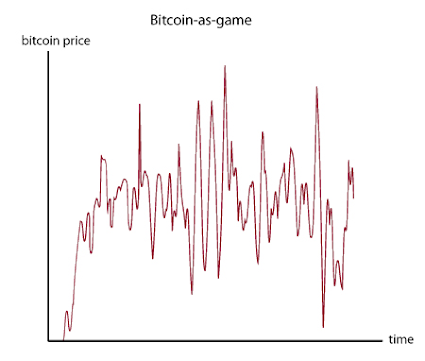
JP Koning provides some advice on whether to buy bitcoin at current levels (around $38,000). He offers three visualizations of the future path for the price of bitcoin to help with that decision. If it’s slowly becoming money then buying and holding, ignoring its diminishing (proportional) volatility is a good strategy. If bitcoin is a bubble, buying could be disastrous because eventually it’ll be worth zero. If bitcoin is a game, it depends if you’re getting into the game early (when bitcoin is a good buy) or late (bad).

I’m intrigued by the “game” scenario, which implies that bitcoin’s price will never stabilize. There will always be big downward and upward spikes, which make it such an exciting game.  And new game players will re-enter to play after every downward spike, re-anchoring bitcoin’s price and setting the stage for the next ramp up. Also, for the foreseeable future, bitcoin’s price will continuously hit a terminal ceiling ($50,000? $200,000?) dictated by its maximum participation rate (5%? 15?). [Read more here, including the comments!]

* To get these updates sent to your inbox, please sign up here. Also, for those interested in intra-day updates and news that didn’t make the Daily Digest cut, please check out my Diigo fintech bookmarks: https://www.diigo.com/user/kiffmeister/Fintech.

Central Bank Digital Currency Workshop, Hosted by the CBDC Think Tank 

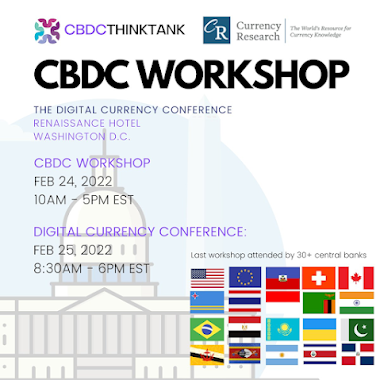
The CBDC Think Tank (CBDCTT)  is hosting an in-person CBDC Workshop in Washington DC on February 24 exclusively for central bank and finance ministry staff looking to understand and position for CBDC issuance.  [Register here]

Kiffmeister’s #Fintech Daily Digest (02/01/2022)*

Diem Confirms Shutdown as Silvergate Acquires the Project’s Assets

Silvergate Bank confirmed that it’s purchasing Diem’s development, deployment and operations tools, as well as tools “for running a blockchain-based payment network” for remittances and other applications.  The Diem Association, the stablecoin project from Meta Platforms,  will “begin the process of winding down” both the group and its subsidiaries over the next few weeks. Silvergate Bank described Diem’s work as running “in a pre-launch phase.” Silvergate CEO Alan Lane said they hope to launch a stablecoin by the end of this year. [Read more]

India to impose 30% tax on crypto income, CBDC in 2022-2023

India will begin levying a 30% tax on all income from crypto-asset transfers, according to the country’s Finance Minister in her budget speech. The 30% tax rate is double the 15% on short capital gains for stocks, but most crypto holders already fall into the 30% tax bracket. A 1% tax will be deducted at source on payments or fees paid in relation to the transfer of crypto-assets. Also the Finance Minister said that a digital rupee will be issued within the coming tax year ending March 2023. [Read more]

Central Bank of Jordan studying the launch of CBDC

Governor of the Central Bank of Jordan reportedly confirmed that the bank is currently studying plans to issue a central bank digital currency (CBDC). These comments were made during a Lower House Economy and Investment Committee meeting on January 30, 2022. [Read more]

Stablecoins: Growth Potential and Impact on Banking

The Fed published a paper that discusses reserve-backed stablecoins’ impact on bank balance sheets and credit intermediation under plausible assumptions. It finds the impact on traditional banking and credit provision can vary depending on the source of inflow and the composition of stablecoin reserves. Among the various scenarios, a two-tiered banking system can support both stablecoin issuance and maintain traditional forms of credit creation. In contrast, a narrow-bank stablecoin framework is the most stable but at the potential cost of credit disintermediation. [Read more]

Thailand axes planned 15% cryptocurrency tax

Thailand has reportedly scrapped plans to impose a 15 per cent withholding tax on crypto transactions after facing pushback from traders in one of south-east Asia’s biggest markets for digital currencies. Tax officials in the country said on Monday that people who earned income from cryptocurrency trading or mining could report these as capital gains on their income taxes. [Read more]

For those of you that missed this late addition to yesterday’s Daily Digest:

Trends of Issuing Central Bank Digital Currency in the Arab Region

An Arab Monetary Fund survey found that 76% of 17 Arab central banks are studying the possibilities of issuing central bank digital currency (CBDC), and three of them are participating in experiments to issue them. Two are expected to issue a CBDC in the next three years, while 60% of them expect to be able to issue within six years. 69% of Arab central banks are in the process of determining the type of CBDC issue, while 25% of them are involved in projects/studies to issue more than one type of CBDCs. Financial inclusion comes at the top of the motives to issue retail CBDCs, while for wholesale CBDCs it is combating money laundering and terrorist financing. [Read more]

* To get these updates sent to your inbox, please sign up here. Also, for those interested in intra-day updates and news that didn’t make the Daily Digest cut, please check out my Diigo fintech bookmarks: https://www.diigo.com/user/kiffmeister/Fintech.

Central Bank Digital Currency Workshop, Hosted by the CBDC Think Tank

The CBDC Think Tank (CBDCTT)  is hosting an in-person CBDC Workshop in Washington DC on February 24 exclusively for central bank and finance ministry staff looking to understand and position for CBDC issuance.  [Register here]

Kiffmeister’s #Fintech Daily Digest (01/31/2022)*

Global developments in wholesale central bank digital currency (CBDC)

Payments Canada published a paper that explores global wholesale CBDC developments in different jurisdictions: Australia, Switzerland, United Arab Emirates and Saudi Arabia. This paper is the fourth installment in Payments Canada’s CBDC educational series. That aims to provide an understanding of a potential CBDC issuance in Canada, along with an exploration of the potential economic and social implications. [Read more]

Trends of Issuing Central Bank Digital Currency in the Arab Region

An Arab Monetary Fund survey found that 76% of 17 Arab central banks are studying the possibilities of issuing central bank digital currency (CBDC), and three of them are participating in experiments to issue them. Two are expected to issue a CBDC in the next three years, while 60% of them expect to be able to issue within six years. 69% of Arab central banks are in the process of determining the type of CBDC issue, while 25% of them are involved in projects/studies to issue more than one type of CBDCs. Financial inclusion comes at the top of the motives to issue retail CBDCs, while for wholesale CBDCs it is combating money laundering and terrorist financing. [Read more]

Blockchain Consensus Mechanisms: A Primer for Supervisors

The IMF published a high-level primer on key aspects of popular blockchain consensus mechanisms, aimed at financial supervisors at central banks, regulatory authorities, and government departments. It focuses specifically on how such mechanisms may impact the mandates of supervisors and policymakers when deployed in financial services markets. It could also help inform IMF staff on policy development and technical assistance related to crypto assets, stablecoins, and blockchains. [Read more]

Crypto risks ‘destabilising’ emerging markets, says senior IMF official

Sharp price swings in cryptocurrencies are causing “destabilizing” capital flows in emerging markets, and the use of crypto in place of traditional currencies poses “immediate and acute risks”, Tobias Adrian, the IMF’s financial counsellor in an interview with the Financial Times. “It is a big challenge for policymakers in some countries… [as] crypto is being used to take money out of countries that are regarded as unstable [by some external investors].” [Read more]

* To get these updates sent to your inbox, please sign up here. Also, for those interested in intra-day updates and news that didn’t make the Daily Digest cut, please check out my Diigo fintech bookmarks: https://www.diigo.com/user/kiffmeister/Fintech.

Central Bank Digital Currency Workshop, Hosted by the CBDC Think Tank 

The CBDC Think Tank (CBDCTT)  is hosting an in-person CBDC Workshop in Washington DC on February 24 exclusively for central bank and finance ministry staff looking to understand and position for CBDC issuance.  [Register here]

Kiffmeister’s #Fintech Daily Digest (01/30/2022)*

David Andolfatto’s Thoughts on the Fed’s CBDC Report

The distinction between synthetic central bank digital currency (sCBDC) and intermediated CBDC (iCBDC) will be of interest mainly to lawyers and regulators. From an economic perspective, the two products appear to be very close–if not perfect–substitutes (assuming their design is optimized). The practical difference between a Federal Reserve liability and a private liability fully-insured by the government seems almost non-existent. [Read more]

This post was sorta in response to the George Selgin critique of the Fed’s CBDC discussion paper, in which he claims that sCBDC is the superior option because it will better promote digital currency (DC) diversity and innovation because it allows for numerous, entirely distinct retail DC, whereas iCBDC provides for a single DC only, albeit one offered and administered by private-sector firms. Both articles are worth a read, especially for the comments. 

There was also a vigorous Twitter thread on the topic that is quite interesting. Although the two articles are U.S.- focused, the discussion around CBDC architecture applies to all retail CBDC design thinking.

Bill Introduced To Make Bitcoin A Legal Tender In Arizona

A bill has been introduced into the Arizona state senate that seeks to add bitcoin to the list of instruments considered legal tender and a lawful medium of exchange in Arizona, enabling residents to pay debts, public charges, taxes and dues with the crypto-asset. What is not clear to me is whether Arizona has what I call a “strong-form” legal tender, by which it’s illegal to refuse payment in legal tender, and whether such a law is enforced. Otherwise it’s quite toothless and meaningless. [Read more]

* To get these updates sent to your inbox, please sign up here. Also, for those interested in intra-day updates and news that didn’t make the Daily Digest cut, please check out my Diigo fintech bookmarks: https://www.diigo.com/user/kiffmeister/Fintech.

Central Bank Digital Currency Workshop, Hosted by the CBDC Think Tank 

The CBDC Think Tank (CBDCTT)  is hosting an in-person CBDC Workshop in Washington DC on February 24 exclusively for central bank and finance ministry staff looking to understand and position for CBDC issuance.  [Register here]

Kiffmeister’s #Fintech Daily Digest (01/29/2022)*

I’ve made some minor updates to my tabulation of retail central bank digital currency (CBDC) explorers. For example, I’ve moved Viet Nam to confirmed explorers, and fixed a few links. Check it out here: https://kiffmeister.com/jurisdictions-where-retail-cbdc-is-being-explored-10-25-2021/.

eNaira: Same Naira, more possibilities for innovation

The Atlantic Council published an article that provides a comprehensive on-the-ground update on Nigeria’s eNaira CBDC launch/pilot (the official press release says “pilot, but it sure looks like a launch). Currently,  only those with bank accounts are currently able to use the eNaira, but the next phase of  the launch/pilot will allow people to register for a “Speed Wallet” with just their National Identification Number (NIN). The central bank hopes to achieve this, along with offline use , through Unstructured Supplementary Service Data (USSD) short codes, which would allow users without a strong internet connection and smartphones to use the CBDC. [Read more]

Caribbean Digital Currency, DCash, Remains Offline for Second Week

Meanwhile, the Eastern Caribbean Central Bank’s DCash, the CBDC used by seven Caribbean nations, has been down since January 14 and it’s unclear when it will be back online. In an email to Bloomberg, Karina Johnson, a DCash project manager at the bank, said officials were working “around the clock” with their service provider Bitt “to re-establish full transaction capabilities.” The Nigerian Central Bank is probably watching this quite nervously, as the eNaira uses the same Bitt platform. [Read more]

4 Reasons Privacy Coins Haven’t Taken Off

Haseeb Qureshi: “The “Cypherpunk’s Manifesto” begins, “Privacy is necessary for an open society in the electronic age.” But privacy coins have failed to take off. Monero and zcash are both worth less today than what they were worth in 2018. Even on darknet markets, where you’d expect privacy coins to thrive, bitcoin is still the asset of choice. Privacy coins have been a disappointment. Why haven’t they taken off? There are four primary reasons.” [Read more

The SEC’s Bitcoin ETF Standoff

Frances Coppola: “There seems to be a profound difference of opinion between the US Securities and Exchange Commission (SEC) and those applying for spot Bitcoin exchange-traded funds. The applicants believe the spot Bitcoin market is resistant to manipulation simply because of the nature of Bitcoin, and don’t see why they should have to provide evidence for what they consider to be self-evident. But the SEC believes the Bitcoin spot market is a hornet’s nest, and in the absence of evidence to the contrary, sees no reason to change its view.” [Read more]

* To get these updates sent to your inbox, please sign up here. Also, for those interested in intra-day updates and news that didn’t make the Daily Digest cut, please check out my Diigo fintech bookmarks: https://www.diigo.com/user/kiffmeister/Fintech.

Central Bank Digital Currency Workshop, Hosted by the CBDC Think Tank 

The CBDC Think Tank (CBDCTT)  is hosting an in-person CBDC Workshop in Washington DC on February 24 exclusively for central bank and finance ministry staff looking to understand and position for CBDC issuance.  [Register here]