
Category: Deposit Tokens
Kiffmeister’s #Fintech Daily Digest (20260927)

Just for the record, I’ve sharpened my description of the People’s Bank of China (PBOC) e-CNY pivot from a central bank digital currency (CBDC) to a tokenized commercial bank deposit platform:
e-CNY 2.0 Pivot from Central Bank Digital Currency to Tokenized Deposits (PBOC)
On December 29, 2025, the People’s Bank of China (PBOC) announced the digital yuan (e-CNY) transition from central bank digital currency to a tokenized commercial bank interest-paying deposit platform. The PBOC also introduced a “global single ledger” (GSL) that operates like a centralized real-time gross settlement system. The GSL binds payment instructions and settlement together to eliminate correspondent clearing delays. The PBOC embeds regulatory nodes into the network to have real-time, comprehensive visibility of all interbank flows for risk management and financial integrity purposes. And to reduce settlement latency, settlement on the GSL is separated from the execution of smart contracts (metadata enabling automated transaction execution based on predefined rules). Smart contract execution is offloaded to parallel, permissioned blockchain networks where programmability acts as a temporary conditional lock. Once conditions are met, the programming is stripped away, and the funds settle across the GSL to the receiving bank as unrestricted money. Only earmarked funds held in sub-wallets retain post-transfer restrictions set by “parent” wallets. [PBOC]
How Pontes (DLT) Reinvented the Time-Out and Got it Wrong (LinkedIn)
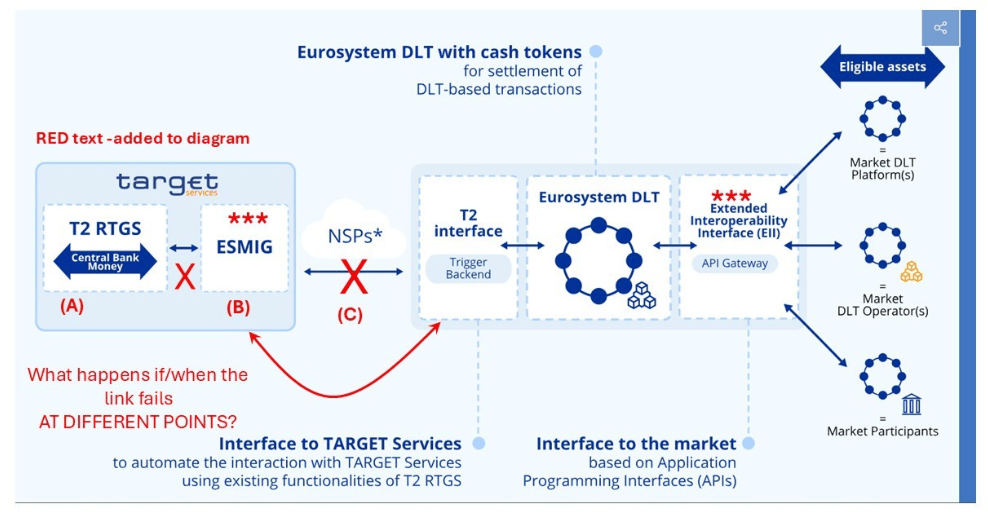
Patrick McConnell, in a September 22 LinkedIn post, argued that the European Central Bank Pontes tokenized asset settlement system pilot utilizes a flawed hash-link protocol (HLP). Pontes employs a dual settlement model, one of which settles cash legs directly in the Eurosystem’s T2 real-time gross settlement system via application programming interface triggers to achieve central bank money settlement finality. Patrick claims the HLP implements time-outs without unique transaction sequence numbers or duplicate identification flags. Consequently, delayed but successful transactions could be erroneously marked unsettled, creating double-payment risks upon resubmission. This vulnerability renders the Eurosystem Single Market Infrastructure Gateway a single point of failure with unpredictable outcomes, violating the Digital Operational Resilience Act. Comments posit that T2’s underlying reconciliation layer reduces the double-payment risk to a “tie-out problem” rather than lost funds, and that the architecture is fundamentally flawed for locking payments before verifying asset availability. [LinkedIn]
BTW if you want to see a complete database of my DFC-related posts going back years, including many that didn’t make the Daily Digest cut, click here.
FYI I produce a monthly digest of digital fiat currency (DFC) developments exclusively for the official sector (e.g., central banks, ministries of finance and international financial institution (e.g., the BIS, IMF, OECD, World Bank)) plus academics and firms that are active in the DFC space (commercial banks, technology providers, consultants, etc.). (DFCs include central bank digital currency (CBDC), stablecoins and tokenized deposits.) It goes out via email on the first business day of every month, and if you’re interested in being on the mailing list, please email me at john@kiffmeister.com.
Kiffmeister’s #Fintech Daily Digest (20260925)

HKMA to Introduce Wholesale CBDC as Project EnsembleTX Settlement Asset (HKMA)
The Hong Kong Monetary Authority (HKMA) is planning to make a wholesale central bank digital currency (CBDC) available for interbank settlement of tokenized deposits as part of Project EnsembleTX, enabling 24/7 payments by around the end of 2026, and will continue to explore more use cases for tokenized deposits. The pilot, launched in November 2025, initially used the HKD real-time gross settlement (RTGS) system to settle the transactions. [HKMA]
ECB Assessing Feasibility of Interlinking TIPS with Brazil’s Pix (ECB)
The European Central Bank (ECB) will assess the feasibility of linking the Eurosystem’s TARGET Instant Payment Settlement (TIPS) platform to Central Bank of Brazil’s Pix instant-payment system. A link could make payments between the euro area and Brazil faster and cheaper, extending the Eurosystem’s broader effort to connect TIPS with foreign instant-payment systems. However, technical, operational, legal and business arrangements remain to be evaluated. [ECB]
US FRB Proposes Rules for FRB-Regulated Stablecoin Issuers (FRB)
The U.S. Federal Reserve Board (FRB) proposed two rules to implement the Guiding and Establishing National Innovation for U.S. Stablecoins (GENIUS) Act for FRB-supervised payment stablecoin issuers: one governing issuance, reserves and supervision, and another governing applications by supervised banks. The first would require full backing with eligible liquid assets, including short-term Treasury bills, and set capital and risk-management standards; it would also regulate reserve-asset safekeeping and clarify permissible bank activities. The second would require applicants to provide a business plan and financial information and establish procedures for appeals and final decisions. Their final terms remain subject to comment, due 60 days after Federal Register publication. [FRB]
BTW if you want to see a complete database of my DFC-related posts going back years, including many that didn’t make the Daily Digest cut, click here.
FYI I produce a monthly digest of digital fiat currency (DFC) developments exclusively for the official sector (e.g., central banks, ministries of finance and international financial institution (e.g., the BIS, IMF, OECD, World Bank)) plus academics and firms that are active in the DFC space (commercial banks, technology providers, consultants, etc.). (DFCs include central bank digital currency (CBDC), stablecoins and tokenized deposits.) It goes out via email on the first business day of every month, and if you’re interested in being on the mailing list, please email me at john@kiffmeister.com.
Kiffmeister’s #Fintech Daily Digest (20260924)

Central Bank of Uzbekistan Exploring Wholesale CBDC (CBU)
[August 30, 2026] At the inaugural Silk Road Finance and Technology Forum (SRFTF), Central Bank of Uzbekistan (CBU) officials outlined a model under consideration in which a wholesale central bank digital currency (CBDC) could provide a trusted settlement layer for privately issued stablecoins, with licensed institutions managing customer relationships and initial testing taking place through a regulatory sandbox. The SRFTF was co-organized by the CBU and the Global Finance & Technology Network (GFTN). The CBU has since posted on its website a white paper co-authored by the GFTN and the Official Monetary and Financial Institutions Forum (OMFIF) that explores the advantages and disadvantages of wholesale CBDCs in the Uzbekistan context. The report assesses if wholesale CBDC could securely improve domestic capital markets and cross-border settlements. However, it critically questions whether alternative synchronization systems might achieve these goals more cost-effectively, proposing a rigorous 24-month evaluative roadmap. [CBU]
Six Canadian Banks Explore Development of a Secure CAD Tokenized Deposit Solution (CIBC)
Six Canadian banks are jointly exploring the development of Canadian dollar based digital money solutions, starting with a tokenized deposits initiative. The project seeks to deliver faster, more efficient and programmable payments to Canadian customers while preserving safety, stability, and effective regulatory oversight. The first phase aims to move tokenized deposits efficiently across Canadian financial institutions with a longer term goal to connect with other emerging digital assets initiatives. The participants are Bank of Montreal (BMO), Canadian Imperial Bank of Commerce (CIBC), National Bank of Canada (NBC), Royal Bank of Canada (RBC), The Bank of Nova Scotia (Scotiabank), and TD Bank Group (TD). The participants anticipate the inclusion of other deposit-taking institutions at the appropriate time. [CIBC]
Kiffmeister’s #Fintech Daily Digest (20260913)

Safe Settlement Assets for Wholesale Tokenized Financial Markets (LinkedIn)
Drawing on remarks delivered at the recent Currency Research Central Bank Payments Conference, Ashley Lannquist (Glenbrook Partners) set out a decision framework for policymakers weighing which form of settlement asset should support safe large-scale tokenized financial markets — settled on distributed ledger technology (DLT). (“Large-scale” denotes markets that would ordinarily settle on a systemically important financial market infrastructure such as a central securities depository or securities settlement system.) Once such activity migrates onto DLT, safety concerns compel a choice governed by whether the asset (1) should be central bank money and (2) should be “on-chain.” The resulting matrix maps to wholesale central bank digital currency (CBDC) (yes/yes), real-time gross settlement (RTGS) synchronization (yes/no), regulated asset-backed stablecoins, tokenized e-money, or tokenized bank deposits (no/yes), and bank deposits (no/no). The framework is not prescriptive, being conditional on country context and acknowledging unresolved empirical questions about benefits and risks. [LinkedIn]

Fast Payment Systems and the Cost of Remittances (Banca d’Italia)
A Banca d’Italia paper by Brandi, Di Iorio, and Nobili concludes that adopting domestic fast payment systems (FPS) reduces inbound remittance costs by roughly 0.25 percentage points. It finds this is primarily achieved by compressing foreign exchange margins via increased non-bank competition. However, the authors temper these findings by highlighting significant regional heterogeneity, noting zero statistically significant cost reductions in Latin America and Europe. Furthermore, they question causality, acknowledging that FPS adoption often coincides with broader regulatory modernization. To defend their thesis, the authors employ an instrumental variable approach using market provider density to isolate whether the FPS itself is the true catalyst for the observed competition and subsequent cost compression. [Banca d’Italia]
BTW if you want to see a complete database of my DFC-related posts going back years, including many that didn’t make the Daily Digest cut, click here.
FYI I produce a monthly digest of digital fiat currency (DFC) developments exclusively for the official sector (e.g., central banks, ministries of finance and international financial institution (e.g., the BIS, IMF, OECD, World Bank)) plus academics and firms that are active in the DFC space (commercial banks, technology providers, consultants, etc.). (DFCs include central bank digital currency (CBDC), stablecoins and tokenized deposits.) It goes out via email on the first business day of every month, and if you’re interested in being on the mailing list, please email me at john@kiffmeister.com.
Protected: Kiffmeister’s Digital Currency Monitor, August 2026
Kiffmeister’s #Fintech Daily Digest (20260827)

Meeting the Challenge of Correspondent Bank Relationship Withdrawals in fully Dollarized Microstates (SSRN)
I have just completed a first draft of a paper that examines emerging digital financial infrastructure and instruments as potential complements to the standard prescriptions aimed at mitigating the domestic financial system risks risks of correspondent banking relationship (CBR) withdrawal in officially dollarized microstates. Such microstates surrender the monetary autonomy of a central bank in exchange for the stability of a foreign currency, and in doing so make their domestic financial systems dependent on CBRs that global banks are increasingly unwilling to maintain. The existing IMF and World Bank literature treats CBR withdrawal primarily as a cross-border payments problem, and its prescriptions are addressed to that dimension. This paper assesses the capacity of emerging digital financial infrastructure and instruments to sustain domestic financial system functionality independent of a CBR, and the extent to which they may allow governments to recapture economic benefits analogous in some respects to the seigniorage that dollarization forgoes. Comments please! [SSRN]
Tokenized Deposits Could Affect Bank Liquidity, Maturity Transformation (Dallas Fed)
The U.S. Federal Reserve Bank of Dallas (Dallas Fed) published an article that claims that widespread tokenized-deposit adoption could erode banks’ maturity-transformation capacity and increase liquidity needs, in the context of real-time payments, stablecoin competition, and emerging bank-led on-chain deposit models. By making deposits more transferable and rate-sensitive, tokenization could shorten their expected life and raise deposit betas, reducing the effective duration that supports longer-term lending. The authors estimate that deposits support roughly 80% of aggregate bank duration exposure; a 10% reduction in deposit life or increase in rate sensitivity could materially reduce capacity or require more term funding, raising credit costs. Faster outflows could also increase demand for reserves and Treasuries. [Dallas Fed]
BTW if you want to see a complete database of my DFC-related posts going back years, including many that didn’t make the Daily Digest cut, click here.
FYI I produce a monthly digest of digital fiat currency (DFC) developments exclusively for the official sector (e.g., central banks, ministries of finance and international financial institution (e.g., the BIS, IMF, OECD, World Bank)) plus academics and firms that are active in the DFC space (commercial banks, technology providers, consultants, etc.). (DFCs include central bank digital currency (CBDC), stablecoins and tokenized deposits.) It goes out via email on the first business day of every month, and if you’re interested in being on the mailing list, please email me at john@kiffmeister.com.
Kiffmeister’s #Fintech Daily Digest (20260812)

BRICS Countries Discussing Linking CBDCs and Fast Payment Systems (Nagaland Post)
Reserve Bank of India (RBI) Governor Sanjay Malhotra reportedly said that BRICS nations are discussing linking central bank digital currencies (CBDCs) and fast payment systems (FPSs) to facilitate cheaper and faster cross-border funds transfers. The BRICS countries are Brazil, Russia, India, China, South Africa, Egypt, Ethiopia, Iran, Saudi Arabia, Indonesia, and the United Arab Emirates (UAE). Governor Malhotra also reportedly said that efforts are on to internationalize the rupee, including by expanding the number of memorandums of understanding (MoUs) between central banks that it signs for promoting bilateral trade in local currencies. At present, India and the RBI have signed such agreements with Indonesia, Maldives, Mauritius and the UAE. [Nagaland Post]
India to Launch CBDC-Based Direct Benefit Transfer POC in Chandigarh and Dadra & Nagar Haveli (GOI)
The Government of India (GOI) will launch programmable central bank digital currency (CBDC) based direct benefit transfers (DBTs) under the Pradhan Mantri Garib Kalyan Anna Yojana (PMGKAY) food subsidy program in the Territories of Chandigarh and Dadra & Nagar Haveli on August 14. With the launch of this scheme the subsidies will be transferred to eligible PMGKAY beneficiaries in the form of programmable digital rupee tokens directly into their CBDC wallets, instead of via traditional bank account transfers. This subsidy can be used to purchase food grains from listed merchants through a secure , trackable, and real-time digital payment system. The aim is to ensure transparent and thorough distribution of public funds , while also reducing leakages , embezzlement, and cash transactions associated with traditional subsidy distribution mechanisms. It will facilitate quick and secure transfer of benefits to beneficiaries and promote financial inclusion through simple wallet-based transactions. This initiative builds on pilots carried out earlier in 2026 in Puducherry and Gujarat, and is envisioned as a proof-of-concept for the nation and a scalable template for adoption by other states and territories. [GOI]
Tokenized Deposits: Old Wine in New Bottles? (SUERF)
SUERF published a policy note by Alistair Milne that argues tokenized deposits offer little operational novelty over conventional account-based deposits, since the automation, programmability, and 24/7 processing attributed to distributed ledger technology are equally achievable on centralized ledgers. Decentralization’s only distinct capability is pseudonymous transfer without intermediaries—which banks are not pursuing. Tokenized deposits’ genuine appeal is confined to “on-us” transactions on a single bank’s balance sheet, avoiding interbank settlement complexity. JP Morgan’s Kinexys, adopted for corporate multi-currency cash management, exemplifies this, but reflects business logic rather than ledger technology. Milne characterizes bank tokenization efforts as a defensive marketing response to the stablecoin threat. Open questions include whether interoperability initiatives such as UK Finance’s tokenized sterling deposits project can generate domestic adoption incentives, and whether capital markets tokenization—requiring 100% reserving and settlement-asset recognition—warrants separate assessment. [SUERF]
BTW if you want to see a complete database of my DFC-related posts going back years, including many that didn’t make the Daily Digest cut, click here.
FYI I produce a monthly digest of digital fiat currency (DFC) developments exclusively for the official sector (e.g., central banks, ministries of finance and international financial institution (e.g., the BIS, IMF, OECD, World Bank)) plus academics and firms that are active in the DFC space (commercial banks, technology providers, consultants, etc.). (DFCs include central bank digital currency (CBDC), stablecoins and tokenized deposits.) It goes out via email on the first business day of every month, and if you’re interested in being on the mailing list, please email me at john@kiffmeister.com.
Kiffmeister’s #Fintech Daily Digest (20260806)

Bank of Korea Establishes Asset Tokenization Unit (Yonhap Infomax)
The Bank of Korea has reportedly established a dedicated asset tokenization unit under its Digital Currency Office as part of a regular mid‑year personnel reshuffle. The unit will lead efforts to tokenize assets, initially focusing on government bonds issued and distributed on a unified ledger integrating wholesale central bank digital currency (CBDC), bank deposits, and tokenized assets. This builds on “Project Hangang,” whose first real‑transaction phase ran from April to June 2025 and whose second phase will start in the second half of 2026 with more participating banks and enhanced functionality. The Korean government’s “2026 Second Half Economic Growth Strategy” also announces a government bond tokenization pilot linked to wholesale CBDC. [Yonhap Infomax]
Some backfilling of stablecoin stories I missed in June:
Open Standard Introduces Open USD Stablecoin (Open Standard)
[June 30, 2026] Open Standard announced Open USD, a consortium‑governed, zero‑fee stablecoin infrastructure for high‑volume, internet‑scale payments, responding to perceived economic and governance constraints in incumbent issuer models. The announcement highlights three pillars: free minting and redemption at any volume, pass‑through of reserve income to partner institutions net a small management fee, and governance via an independent company whose board is drawn from those partners. A large set of global banks, card networks, payment processors, technology platforms, and crypto firms have committed to integrate or support Open USD, positioning it as shared rails rather than proprietary product. The project’s significance lies in its attempt to reallocate stablecoin seigniorage and formalize multi‑firm governance, with unresolved issues around regulatory treatment, reserve composition, risk management, and actual decision‑making power distribution. [Open Standard]
Japan’s Three Largest Banks Aim for Joint Stablecoin Issue by March 2027 (Coin Desk)
[June 10, 2026] Japan’s three largest banking groups plan to issue a jointly branded yen stablecoin by March 2027, under a trust-bank structure backed by Japan’s Financial Services Agency and ruling party support for yen tokens. Mitsubishi UFJ Financial Group (MUFG), Sumitomo Mitsui Financial Group (SMBC) and Mizuho Financial Group will form a council to design the operational framework, act as joint settlors, and appoint a trust bank or similar institution as trustee, indicating a balance-sheet-light, segregated-assets model aligned with Japan’s stablecoin law. This will create a regulated, large-scale yen stablecoin in a market currently dominated by U.S dollar tokens and where yen stablecoins remain below $50 million outstanding, with the leading token JPYC at around $18 million. Key unresolved issues are detailed operational design, legal treatment under evolving stablecoin rules, and how participation will extend beyond the initial three banks. [Coin Desk]
BTW if you want to see a complete database of my DFC-related posts going back years, including many that didn’t make the Daily Digest cut, click here.
FYI I produce a monthly digest of digital fiat currency (DFC) developments exclusively for the official sector (e.g., central banks, ministries of finance and international financial institution (e.g., the BIS, IMF, OECD, World Bank)) plus academics and firms that are active in the DFC space (commercial banks, technology providers, consultants, etc.). (DFCs include central bank digital currency (CBDC), stablecoins and tokenized deposits.) It goes out via email on the first business day of every month, and if you’re interested in being on the mailing list, please email me at john@kiffmeister.com.
Kiffmeister’s #Fintech Daily Digest (20260802)

China Cuts Durian Settlement to 30 Minutes with First Outbound e-CNY Payment to Malaysia (SCMP)
China has completed its first outbound payment via the Cross‑Border e‑CNY Express Service (CBETS) to Malaysia, settling a 43,000 yuan shipment of fresh durian. The transaction was executed by China Construction Bank’s Xiamen branch in coordination with its Labuan branch in Malaysia, using direct bank‑to‑bank ledger transfers and on‑the‑fly conversion into Malaysian ringgit. Compared with traditional correspondent banking networks operating under the Society for Worldwide Interbank Financial Telecommunication (SWIFT) system, this cut settlement to 30 minutes from one to three days and eliminated clearing fees of up to 6% and per‑transaction charges of $25 to $35. CBETS, operated by the e‑CNY International Operation Center under the guidance of the People’s Bank of China’s Digital Currency Institute, provides on‑chain and off‑chain connectivity and 24/7 cross‑border settlement. [SCMP]
FYI most publications are presenting this as a central bank digital currency (CBDC) story, but there’s no concrete evidence that it is. For starters, the Peoples Bank of China (PBOC) announced earlier in the year that the e-CNY is now a tokenized commercial bank deposit-based platform. And earlier stories going back to September 2025 (see below) that I missed make it clear that the Cross‑Border e‑CNY Express Service (CBETS) platform is only operating under PBOC guidance, so none of these platforms are CBDC-based according to the core part of the CBDC definition; a direct liability of the central bank.
26 Financial Institutions Sign On as direct participants with e-CNY Center International (SCIO)
[June 17, 2026] The State Council Information Office of China (SCIO) announced that the e‑CNY International Operation Center, which operates under the guidance of the Digital Currency Institute of the People’s Bank of China, has enrolled 26 institutions as direct participants on its Cross-Border e-CNY Transfer Services (CBETS) platform. Since the beginning of 2026, the e-CNY International Operations Center, which commenced operations in September 2025, has upgraded its three major platforms into the CBETS. CBETS provides on-chain and off-chain connectivity and 24/7 settlement, reducing reliance on three-to-five intermediary correspondent banks per transaction. The 26 aforementioned institutions include Standard Chartered China and Chinese bank branches in Thailand, Singapore, Laos, and Qatar. [SCIO]
e-CNY International Operation Center Officially Launched in Shanghai (PBOC)
[September 25, 2025] The People’s Bank of China (PBOC) formally launched the e‑CNY International Operation Center in Shanghai to provide dedicated infrastructure for cross‑border use of the digital renminbi, framed as part of a broader upgrade of monetary and payment systems. The center’s three core “business platforms” are a cross‑border digital payment platform, a blockchain service platform, and a digital asset platform, together supporting e‑CNY cross‑border settlement, asset tokenization, and related digital financial services. Institutionally, the PBOC’s Digital Currency Institute will build and operate these systems, with a mandate to connect domestic and foreign financial infrastructures and support international operation of e‑CNY. [PBOC]
BTW if you want to see a complete database of my DFC-related posts going back years, including many that didn’t make the Daily Digest cut, click here.
FYI I produce a monthly digest of digital fiat currency (DFC) developments exclusively for the official sector (e.g., central banks, ministries of finance and international financial institution (e.g., the BIS, IMF, OECD, World Bank)) plus academics and firms that are active in the DFC space (commercial banks, technology providers, consultants, etc.). (DFCs include central bank digital currency (CBDC), stablecoins and tokenized deposits.) It goes out via email on the first business day of every month, and if you’re interested in being on the mailing list, please email me at john@kiffmeister.com.