Kiffmeister’s #Fintech Daily Digest (20260927)

Just for the record, I’ve sharpened my description of the People’s Bank of China (PBOC) e-CNY pivot from a central bank digital currency (CBDC) to a tokenized commercial bank deposit platform:

e-CNY 2.0 Pivot from Central Bank Digital Currency to Tokenized Deposits (PBOC)

On December 29, 2025, the People’s Bank of China (PBOC) announced the digital yuan (e-CNY) transition from central bank digital currency to a tokenized commercial bank interest-paying deposit platform. The PBOC also introduced a “global single ledger” (GSL) that operates like a centralized real-time gross settlement system. The GSL binds payment instructions and settlement together to eliminate correspondent clearing delays. The PBOC embeds regulatory nodes into the network to have real-time, comprehensive visibility of all interbank flows for risk management and financial integrity purposes. And to reduce settlement latency, settlement on the GSL is separated from the execution of smart contracts (metadata enabling automated transaction execution based on predefined rules). Smart contract execution is offloaded to parallel, permissioned blockchain networks where programmability acts as a temporary conditional lock. Once conditions are met, the programming is stripped away, and the funds settle across the GSL to the receiving bank as unrestricted money. Only earmarked funds held in sub-wallets retain post-transfer restrictions set by “parent” wallets. [PBOC]

How Pontes (DLT) Reinvented the Time-Out and Got it Wrong (LinkedIn)

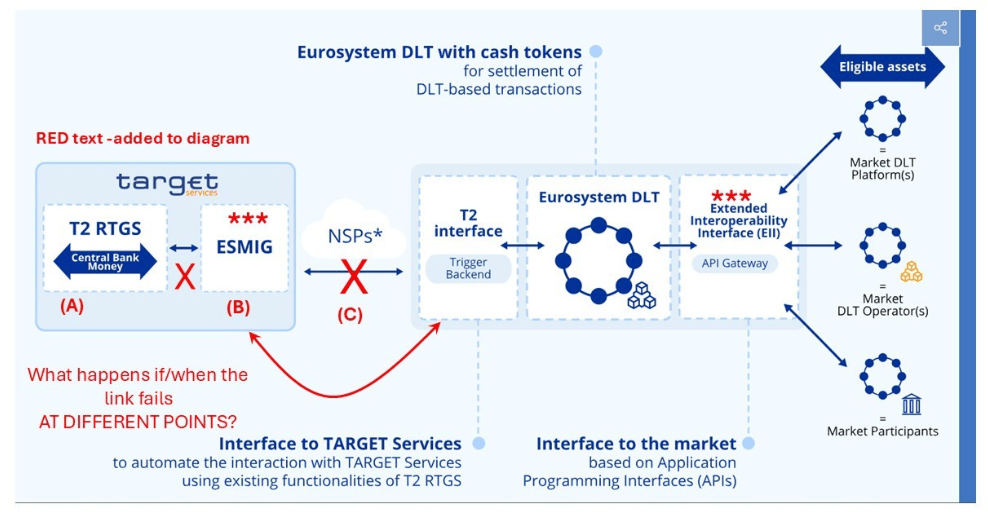
Patrick McConnell, in a September 22 LinkedIn post, argued that the European Central Bank Pontes tokenized asset settlement system pilot utilizes a flawed hash-link protocol (HLP). Pontes employs a dual settlement model, one of which settles cash legs directly in the Eurosystem’s T2 real-time gross settlement system via application programming interface triggers to achieve central bank money settlement finality. Patrick claims the HLP implements time-outs without unique transaction sequence numbers or duplicate identification flags. Consequently, delayed but successful transactions could be erroneously marked unsettled, creating double-payment risks upon resubmission. This vulnerability renders the Eurosystem Single Market Infrastructure Gateway a single point of failure with unpredictable outcomes, violating the Digital Operational Resilience Act. Comments posit that T2’s underlying reconciliation layer reduces the double-payment risk to a “tie-out problem” rather than lost funds, and that the architecture is fundamentally flawed for locking payments before verifying asset availability. [LinkedIn]
BTW if you want to see a complete database of my DFC-related posts going back years, including many that didn’t make the Daily Digest cut, click here.

FYI I produce a monthly digest of digital fiat currency (DFC) developments exclusively for the official sector (e.g., central banks, ministries of finance and international financial institution (e.g., the BIS, IMF, OECD, World Bank)) plus academics and firms that are active in the DFC space (commercial banks, technology providers, consultants, etc.). (DFCs include central bank digital currency (CBDC), stablecoins and tokenized deposits.) It goes out via email on the first business day of every month, and if you’re interested in being on the mailing list, please email me at john@kiffmeister.com.

Kiffmeister’s #Fintech Daily Digest (20260925)

HKMA to Introduce Wholesale CBDC as Project EnsembleTX Settlement Asset (HKMA)

The Hong Kong Monetary Authority (HKMA) is planning to make a wholesale central bank digital currency (CBDC) available for interbank settlement of tokenized deposits as part of Project EnsembleTX, enabling 24/7 payments by around the end of 2026, and will continue to explore more use cases for tokenized deposits. The pilot, launched in November 2025, initially used the HKD real-time gross settlement (RTGS) system to settle the transactions. [HKMA]

ECB Assessing Feasibility of Interlinking TIPS with Brazil’s Pix (ECB)

The European Central Bank (ECB) will assess the feasibility of linking the Eurosystem’s TARGET Instant Payment Settlement (TIPS) platform to Central Bank of Brazil’s Pix instant-payment system. A link could make payments between the euro area and Brazil faster and cheaper, extending the Eurosystem’s broader effort to connect TIPS with foreign instant-payment systems. However, technical, operational, legal and business arrangements remain to be evaluated. [ECB]

US FRB Proposes Rules for FRB-Regulated Stablecoin Issuers (FRB)

The U.S. Federal Reserve Board (FRB) proposed two rules to implement the Guiding and Establishing National Innovation for U.S. Stablecoins (GENIUS) Act for FRB-supervised payment stablecoin issuers: one governing issuance, reserves and supervision, and another governing applications by supervised banks. The first would require full backing with eligible liquid assets, including short-term Treasury bills, and set capital and risk-management standards; it would also regulate reserve-asset safekeeping and clarify permissible bank activities. The second would require applicants to provide a business plan and financial information and establish procedures for appeals and final decisions. Their final terms remain subject to comment, due 60 days after Federal Register publication. [FRB]

BTW if you want to see a complete database of my DFC-related posts going back years, including many that didn’t make the Daily Digest cut, click here.

FYI I produce a monthly digest of digital fiat currency (DFC) developments exclusively for the official sector (e.g., central banks, ministries of finance and international financial institution (e.g., the BIS, IMF, OECD, World Bank)) plus academics and firms that are active in the DFC space (commercial banks, technology providers, consultants, etc.). (DFCs include central bank digital currency (CBDC), stablecoins and tokenized deposits.) It goes out via email on the first business day of every month, and if you’re interested in being on the mailing list, please email me at john@kiffmeister.com.

Kiffmeister’s #Fintech Daily Digest (20260921)(Second Revision)

On further consideration, I am fully walking back my contention that the European Central Bank (ECB) Pontes pilot “cash tokens” are not tokenized central bank money (CeBM) or wholesale central bank digital currency (CBDC). Based on the standard Bank for International Settlements (BIS) definition of a CBDC (a digital liability of the central bank denominated in the national unit of account), the cash tokens unambiguously qualify. In my first revision of the September post, I had appended an additional condition that the transfer of the digital instrument must constitute instantaneous, unconditional, and legal settlement finality natively on the primary ledger. Because the current Pontes architecture relies on a subsequent defunding event in T2 to achieve ultimate legal finality, I argued they functioned as transitional settlement proxies (effectively TARGET-linked depository receipts) rather than true wholesale CBDCs. I now recognize that appending this strict settlement-timing condition to the base definition was a mistake. While the distinction between technical and legal finality remains a critical architectural discussion regarding systemic risk, it should not disqualify an instrument from being classified as a CBDC. Moving forward, I am sticking strictly to the BIS definition. Sorry for all the whipsawing!

Eurosystem Brings Central Bank Money to Tokenized Finance (ECB)

The European Central Bank (ECB) launched Pontes to enable wholesale transactions in tokenized assets to be settled in central bank money via Trans-European Automated Real-time Gross Settlement Express Transfer (TARGET) Services. Operating as a consolidated interoperability solution, Pontes integrates the strengths of the Eurosystem’s 2024 exploratory trials. It features a dual settlement model that allows participants to settle the cash leg of transactions either directly in T2 (the Eurosystem’s real-time gross settlement system) via application programming interface (API) based triggers, or on the Eurosystem distributed ledger technology (DLT) platform utilizing cash tokens (a claim on the ECB to transfer the equivalent CeBM in T2) and dedicated DLT wallets. In both cases, legal settlement finality in CeBM occurs in T2 — for cash tokens, upon defunding or the mandatory end-of-day sweep back into T2 accounts. The hash-link protocol is specifically utilized to ensure secure, synchronized delivery versus payment (DvP) across platforms. Pontes will initially offer a core set of services, with enhanced features and extended operating hours introduced gradually toward full implementation by 2028. [ECB]

ECB to Invest Part of Own Funds in Tokenized Securities, with Settlement via Pontes (ECB)

The European Central Bank (ECB) is initiating investments of its own funds in tokenized, euro-denominated public sector securities to build institutional expertise in distributed ledger technology (DLT). Transactions will settle in central bank money via the Eurosystem’s newly launched Pontes solution, supporting the broader Appia initiative for a European tokenized financial ecosystem. [ECB]

BTW if you want to see a complete database of my DFC-related posts going back years, including many that didn’t make the Daily Digest cut, click here.

FYI I produce a monthly digest of digital fiat currency (DFC) developments exclusively for the official sector (e.g., central banks, ministries of finance and international financial institution (e.g., the BIS, IMF, OECD, World Bank)) plus academics and firms that are active in the DFC space (commercial banks, technology providers, consultants, etc.). (DFCs include central bank digital currency (CBDC), stablecoins and tokenized deposits.) It goes out via email on the first business day of every month, and if you’re interested in being on the mailing list, please email me at john@kiffmeister.com.

Kiffmeister’s #Fintech Daily Digest (20260917)

U.S. SEC Issues Innovation Exemption to Facilitate the Trading of Tokenized NMS Stock (SEC)

The U.S. Securities and Exchange Commission (SEC) granted temporary exemptive relief to tokenized securities venues (TSVs) from the definition of “exchange” in the Securities Exchange Act of 1934 to trade tokenized National Market System (NMS) stock using innovative permissioned automated market makers and liquidity pools. The relief creates a five-year, bounded pathway for on-chain secondary trading and proprietary-capital liquidity provision without immediate exchange or dealer registration. It is conditioned on limits on symbols and volume, equivalent shareholder rights, issuer notice for third-party tokenization, auditable public smart contracts, synchronized trading halts, and transparency. The SEC will solicit comment before deciding whether durable rulemaking is warranted. Unresolved issues include appropriate scale, market-structure safeguards, issuer control, and the regulatory treatment of liquidity providers. [SEC]

Money and Power: Lessons from History for Stablecoins and US Dollar Dominance (BOE)

External member of the Bank of England (BOE) Financial Policy Committee Carolyn Wilkins concludes that while private digital currencies could theoretically scale, their stability remains highly conditional on credible convertibility, uniform regulation, and robust crisis-management frameworks. Probing the implications of expanding U.S. dollar stablecoins, she notes potential benefits for dollar settlement but questions their resilience during panics, warning that ostensibly liquid reserve assets may suffer severe liquidity deficits under systemic stress. Furthermore, Wilkins identifies regulatory heterogeneity across jurisdictions as a critical vulnerability complicating cross-border enforcement. She ultimately cautions against assuming technology guarantees dominance, asserting that enduring international monetary power depends strictly on fundamental fiscal capacity, institutional credibility, and the rule of law rather than mere network effects. [BOE]

And some catching up to something I missed in 2025:

NBKR Sets Out Digital Som Project Sequencing (NBKR)

[March 10, 2025] The National Bank of the Kyrgyz Republic (NBKR) laid out its plans to issue a blockchain-based Digital Som central bank digital currency (CBDC) to enhance financial inclusion, payment security, and digital economy infrastructure. Following the the IMF’s “5P” methodology, the project will progress sequentially from initial proof-of-concept functional testing to limited-user prototyping, followed by a live pilot before fully launch (“production”). Over the 2027–2030 horizon, the central bank aims to incorporate smart contracts for programmable payments, establish cross-border interoperability with foreign platforms, and optimize throughput and cyber resilience, supported in parallel by a dedicated regulatory framework governing platform operators and participant connectivity. [NBKR]

BTW if you want to see a complete database of my DFC-related posts going back years, including many that didn’t make the Daily Digest cut, click here.

FYI I produce a monthly digest of digital fiat currency (DFC) developments exclusively for the official sector (e.g., central banks, ministries of finance and international financial institution (e.g., the BIS, IMF, OECD, World Bank)) plus academics and firms that are active in the DFC space (commercial banks, technology providers, consultants, etc.). (DFCs include central bank digital currency (CBDC), stablecoins and tokenized deposits.) It goes out via email on the first business day of every month, and if you’re interested in being on the mailing list, please email me at john@kiffmeister.com.

Kiffmeister’s #Fintech Daily Digest (20260913)

Safe Settlement Assets for Wholesale Tokenized Financial Markets (LinkedIn)

Drawing on remarks delivered at the recent Currency Research Central Bank Payments Conference, Ashley Lannquist (Glenbrook Partners) set out a decision framework for policymakers weighing which form of settlement asset should support safe large-scale tokenized financial markets — settled on distributed ledger technology (DLT). (“Large-scale” denotes markets that would ordinarily settle on a systemically important financial market infrastructure such as a central securities depository or securities settlement system.) Once such activity migrates onto DLT, safety concerns compel a choice governed by whether the asset (1) should be central bank money and (2) should be “on-chain.” The resulting matrix maps to wholesale central bank digital currency (CBDC) (yes/yes), real-time gross settlement (RTGS) synchronization (yes/no), regulated asset-backed stablecoins, tokenized e-money, or tokenized bank deposits (no/yes), and bank deposits (no/no). The framework is not prescriptive, being conditional on country context and acknowledging unresolved empirical questions about benefits and risks. [LinkedIn]

Fast Payment Systems and the Cost of Remittances (Banca d’Italia)

A Banca d’Italia paper by Brandi, Di Iorio, and Nobili concludes that adopting domestic fast payment systems (FPS) reduces inbound remittance costs by roughly 0.25 percentage points. It finds this is primarily achieved by compressing foreign exchange margins via increased non-bank competition. However, the authors temper these findings by highlighting significant regional heterogeneity, noting zero statistically significant cost reductions in Latin America and Europe. Furthermore, they question causality, acknowledging that FPS adoption often coincides with broader regulatory modernization. To defend their thesis, the authors employ an instrumental variable approach using market provider density to isolate whether the FPS itself is the true catalyst for the observed competition and subsequent cost compression. [Banca d’Italia]

BTW if you want to see a complete database of my DFC-related posts going back years, including many that didn’t make the Daily Digest cut, click here.

FYI I produce a monthly digest of digital fiat currency (DFC) developments exclusively for the official sector (e.g., central banks, ministries of finance and international financial institution (e.g., the BIS, IMF, OECD, World Bank)) plus academics and firms that are active in the DFC space (commercial banks, technology providers, consultants, etc.). (DFCs include central bank digital currency (CBDC), stablecoins and tokenized deposits.) It goes out via email on the first business day of every month, and if you’re interested in being on the mailing list, please email me at john@kiffmeister.com.

Kiffmeister’s #Fintech Daily Digest (20260911)

Launch of Demat 2.0 Tokenized Corporate Bond Project (SEBI)

The Securities and Exchange Board of India (SEBI) launched the “Demat 2.0” pilot project, introducing tokenized corporate bonds natively recorded on a distributed ledger. It utilizes the Reserve Bank of India’s wholesale central bank digital currency (CBDC) and Unified Market Interface to enable instantaneous atomic settlement, using smart contracts to automate interest and redemption payments. Unlike global precedents—which largely involve individual issuers on isolated platforms—Demat 2.0 natively embeds tokenized bonds and CBDC settlement directly within India’s existing regulated market infrastructure. Following an initial ₹1,025 crore issuance by three companies, the pilot aims to reduce costs and settlement risks. While the technology changes, investor safeguards, legal rights, and regulatory frameworks remain identical to conventional bonds, with future phases planned for retail access. [SEBI]

BTW if you want to see a complete database of my DFC-related posts going back years, including many that didn’t make the Daily Digest cut, click here.

FYI I produce a monthly digest of digital fiat currency (DFC) developments exclusively for the official sector (e.g., central banks, ministries of finance and international financial institution (e.g., the BIS, IMF, OECD, World Bank)) plus academics and firms that are active in the DFC space (commercial banks, technology providers, consultants, etc.). (DFCs include central bank digital currency (CBDC), stablecoins and tokenized deposits.) It goes out via email on the first business day of every month, and if you’re interested in being on the mailing list, please email me at john@kiffmeister.com.

Kiffmeister’s #Fintech Daily Digest (20260906)

Navigating the Purpose and Provision of CBDC (IJPE)

In the International Journal of Political Economy (IJPE), George Pantelopoulos argues that one purpose of central bank digital currency (CBDC) is to preserve the fungibility of privately issued means of payment. Through the retail anchor function of central bank money, convertibility into banknotes bridges heterogeneities among forms of private money and forges a symbiosis between them, preventing commercial bank money from de-anchoring and thereby averting adverse selection and fractured monetary sovereignty. With banknotes declining as a means of payment, however, this convertibility risks becoming a merely theoretical rather than real-world construct — a gap that could justify introducing CBDC. Separately, the paper contends that genuine CBDC must be booked as a direct central bank liability; “synthetic CBDC” schemes, being central-bank-backed e-money issued by intermediaries, do not qualify. A two-tier architecture is presented as the most likely means of preserving this liability structure without requiring the central bank to hold retail accounts. [IJPE]

The Alchemy of Fungible Money: A Trilateral Approach to Bridging Heterogeneities (SSRN)

George Pantelopoulos and Paul Wessels posted a paper on the Social Science Research Network (SSRN) that challenges the prevailing “moneyness” policy focus on “singleness” – the property that payments denominated in the sovereign unit of account will be settled at par, even if they use different forms of privately and publicly issued monies. The authors argue that settlement at par is merely one component of true interchangeability. Even when instruments like commercial bank deposits, e-money, and stablecoins exchange at par, unmitigated heterogeneities in credit risk and accessibility can still trigger adverse selection and systemic instability during market stress. To achieve practical fungibility, they propose a trilateral framework of foundational (unit of account), enabling (convertibility, deterministic settlement finality, interoperability), and supportive (regulation, deposit insurance) elements. As physical cash usage declines, the analysis questions whether decentralized innovations like stablecoins and tokenized deposits can sufficiently replicate these complex institutional support mechanisms to achieve practical fungibility. [SSRN]

Tokenized Finance and The Perimeter of Central Banking (KC Fed)

Darrell Duffie presented a paper at the Kansas City Fed (KC Fed) Jackson Hole Conference that evaluates how central banks can support safe settlement for large-scale tokenized finance without expanding their operational perimeter. He analyzes infrastructure models based on financial stability, central-bank balance sheet size, and fragmentation costs, warning that poor interoperability will severely delay tokenization’s growth. Duffie assesses four approaches: (1) providing tokenized central-bank reserves, (2) synchronizing extended-hour conventional payment systems with programmable ledgers, (3) authorizing private-sector narrow banks to offer tokenized deposits via central-bank omnibus accounts, and (4) utilizing wholesale stablecoins. He predicts central banks will likely delegate tokenization to private-sector narrow banks (approach 3) to avoid building 24×7 programmable ledgers themselves. He dismisses stablecoins as inferior for financial stability; as claims on private issuers, they carry vulnerabilities like liquidity transformation and contagion, lacking the safety of central bank money. [KC Fed]

BTW if you want to see a complete database of my DFC-related posts going back years, including many that didn’t make the Daily Digest cut, click here.

FYI I produce a monthly digest of digital fiat currency (DFC) developments exclusively for the official sector (e.g., central banks, ministries of finance and international financial institution (e.g., the BIS, IMF, OECD, World Bank)) plus academics and firms that are active in the DFC space (commercial banks, technology providers, consultants, etc.). (DFCs include central bank digital currency (CBDC), stablecoins and tokenized deposits.) It goes out via email on the first business day of every month, and if you’re interested in being on the mailing list, please email me at john@kiffmeister.com.

Kiffmeister’s #Fintech Daily Digest (20260903)

Digital Currency in the Australian Context: An Update (RBA)

The Reserve Bank of Australia (RBA) and the Australian Government Treasury published reports that concluded that Australia’s retail payment system is serving households and businesses well, and that there is no clear public interest case for a retail central bank digital currency (CBDC). This is consistent with the conclusions of the 2024 “Central Bank Digital Currency and the Future of Digital Money in Australia” RBA and Treasury joint paper. The new assessment drew on a public consultation conducted by Verian Group, which asked Australians about their payment needs and views on a potential retail CBDC. Going forward, the RBA will continue monitoring developments in retail payments, cash accessibility, tokenized money, consumer payment preferences and digital finance domestically and internationally, to ensure it remains well placed to reassess the case for a retail CBDC should circumstances (and the policy case) change in the future. In the meantime, the RBA remains committed to progressing an ambitious range of initiatives in wholesale markets and money, including a coordinated work program on wholesale tokenized finance. [RBA]

The Role of RITS in Supporting Settlement in a Tokenized Ecosystem (RBA)

The Reserve Bank of Australia (RBA) launched a consultation on the roles of the Reserve Bank Information and Transfer System (RITS) (the RBA’s real-time gross settlement (RTGS) platform) and Fast Settlement System (FSS) (the RBA’s fast payment platform) in supporting settlement in a tokenized ecosystem. As highlighted in the May 2026 Project Acacia final report, tokenization has the potential to enhance the efficiency, functionality and resilience of Australia’s wholesale financial markets. The consultation seeks views on how the RBA’s settlement services could support the development and growth of tokenized asset markets and tokenized private money in Australia, while continuing to promote safety, efficiency and financial stability. The consultation is one of several initiatives identified in Project Acacia as forming the basis of a future program of work aimed at ensuring Australia’s money, payments and settlement arrangements remain fit for the future. The RBA is also seeking views on key design considerations for tokenized central bank reserves. [RBA]

Harneys and droppRWA Plan First Blockchain-Recorded Catastrophe Bond Issue (Coindesk)

Harneys, a global offshore law firm originally established in the British Virgin Islands, and droppRWA, a Bermuda-based tokenization platform, reportedly plan to issue tokenized catastrophe (CAT) bonds by 2027, transitioning legal ownership directly onto a blockchain. This could compress reconciliation from days to seconds and reduce minimum investments from $250,000 to $5,000 via beneficial interest vehicles. The project is still pending applicable regulatory requirements and approvals. Any platform administrator role would be subject to licensing under Bermuda’s Digital Asset Business Act 2018. [Coindesk]

BTW if you want to see a complete database of my DFC-related posts going back years, including many that didn’t make the Daily Digest cut, click here.

FYI I produce a monthly digest of digital fiat currency (DFC) developments exclusively for the official sector (e.g., central banks, ministries of finance and international financial institution (e.g., the BIS, IMF, OECD, World Bank)) plus academics and firms that are active in the DFC space (commercial banks, technology providers, consultants, etc.). (DFCs include central bank digital currency (CBDC), stablecoins and tokenized deposits.) It goes out via email on the first business day of every month, and if you’re interested in being on the mailing list, please email me at john@kiffmeister.com.

Kiffmeister’s #Fintech Daily Digest (20260826)

India Plans First Tokenized Corporate Bond Issue in September (Reuters)

India will reportedly pilot its first tokenized corporate bond issuance in September, with state-owned power financier Rural Electrification Corporation (REC) Limited issuing under 5 billion rupees in blockchain-recorded notes settled via the central bank digital currency (CBDC). The Reserve Bank of India and the markets regulator are jointly developing the framework, requiring investors to hold both a wholesale CBDC wallet and a new distributed-ledger securities wallet (“DEMAT 2.0”) built by depositories, rather than trading on conventional electronic book platforms. Access is restricted to a select investor group at the pilot stage, bonds carry a three-month lock-in, and a secondary market is only expected by December, leaving interoperability and scaling questions unresolved. [Reuters]

Japan Eyes Blockchain for Instant Stock, Government Bond Settlement (Nikkei)

Japan’s Ministry of Finance (MOF) and the Bank of Japan (BOJ) reportedly plan to develop a blockchain-based platform to support real-time 24/7 settlement of government bond and stock transactions using a wholesale central bank digital currency (CBDC). A study group involving the MOF, BOJ, Financial Services Agency, and financial institutions will soon be established, with a development plan expected to be finalized by early 2027, with a view to launching in the early 2030s. [Nikkei]

BTW if you want to see a complete database of my DFC-related posts going back years, including many that didn’t make the Daily Digest cut, click here.

FYI I produce a monthly digest of digital fiat currency (DFC) developments exclusively for the official sector (e.g., central banks, ministries of finance and international financial institution (e.g., the BIS, IMF, OECD, World Bank)) plus academics and firms that are active in the DFC space (commercial banks, technology providers, consultants, etc.). (DFCs include central bank digital currency (CBDC), stablecoins and tokenized deposits.) It goes out via email on the first business day of every month, and if you’re interested in being on the mailing list, please email me at john@kiffmeister.com.

Kiffmeister’s #Fintech Daily Digest (20260806)

Bank of Korea Establishes Asset Tokenization Unit (Yonhap Infomax)

The Bank of Korea has reportedly established a dedicated asset tokenization unit under its Digital Currency Office as part of a regular mid‑year personnel reshuffle. The unit will lead efforts to tokenize assets, initially focusing on government bonds issued and distributed on a unified ledger integrating wholesale central bank digital currency (CBDC), bank deposits, and tokenized assets. This builds on “Project Hangang,” whose first real‑transaction phase ran from April to June 2025 and whose second phase will start in the second half of 2026 with more participating banks and enhanced functionality. The Korean government’s “2026 Second Half Economic Growth Strategy” also announces a government bond tokenization pilot linked to wholesale CBDC. [Yonhap Infomax]

Some backfilling of stablecoin stories I missed in June:

Open Standard Introduces Open USD Stablecoin (Open Standard)

[June 30, 2026] Open Standard announced Open USD, a consortium‑governed, zero‑fee stablecoin infrastructure for high‑volume, internet‑scale payments, responding to perceived economic and governance constraints in incumbent issuer models. The announcement highlights three pillars: free minting and redemption at any volume, pass‑through of reserve income to partner institutions net a small management fee, and governance via an independent company whose board is drawn from those partners. A large set of global banks, card networks, payment processors, technology platforms, and crypto firms have committed to integrate or support Open USD, positioning it as shared rails rather than proprietary product. The project’s significance lies in its attempt to reallocate stablecoin seigniorage and formalize multi‑firm governance, with unresolved issues around regulatory treatment, reserve composition, risk management, and actual decision‑making power distribution. [Open Standard]

Japan’s Three Largest Banks Aim for Joint Stablecoin Issue by March 2027 (Coin Desk)

[June 10, 2026] Japan’s three largest banking groups plan to issue a jointly branded yen stablecoin by March 2027, under a trust-bank structure backed by Japan’s Financial Services Agency and ruling party support for yen tokens. Mitsubishi UFJ Financial Group (MUFG), Sumitomo ⁠Mitsui Financial Group (SMBC) and Mizuho Financial Group will form a council to design the operational framework, act as joint settlors, and appoint a trust bank or similar institution as trustee, indicating a balance-sheet-light, segregated-assets model aligned with Japan’s stablecoin law. This will create a regulated, large-scale yen stablecoin in a market currently dominated by U.S dollar tokens and where yen stablecoins remain below $50 million outstanding, with the leading token JPYC at around $18 million. Key unresolved issues are detailed operational design, legal treatment under evolving stablecoin rules, and how participation will extend beyond the initial three banks. [Coin Desk]

BTW if you want to see a complete database of my DFC-related posts going back years, including many that didn’t make the Daily Digest cut, click here.

FYI I produce a monthly digest of digital fiat currency (DFC) developments exclusively for the official sector (e.g., central banks, ministries of finance and international financial institution (e.g., the BIS, IMF, OECD, World Bank)) plus academics and firms that are active in the DFC space (commercial banks, technology providers, consultants, etc.). (DFCs include central bank digital currency (CBDC), stablecoins and tokenized deposits.) It goes out via email on the first business day of every month, and if you’re interested in being on the mailing list, please email me at john@kiffmeister.com.