Kiffmeister’s #Fintech Daily Digest (20220707)

Binance brings Bitcoin trading fees to zero

Binance will cut Bitcoin (BTC) trading fees to zero worldwide on July 8, to coincide with the exchange’s five-year anniversary. It will remain in place until further notice. Zero-fee trading will cover the following 13 spot trading pairs: BTC/AUD, BTC/BIDR, BTC/BRL, BTC/BUSD, BTC/EUR, BTC/GBP, BTC/RUB, BTC/TRY, BTC/TUSD, BTC/UAH, BTC/USDC, BTC/USDP and BTC/USDT. [Read more]

Disclosure, Dapps and DeFi

A paper by Chris Brummer and Agnes N. Williams highlights, with respect to decentralized finance (DeFi) in a U.S. context, the ambiguities inhabiting legacy disclosure obligations and offers a conceptual roadmap for assisting developers and regulators. Furthermore, it introduces a series of crypto-native tools to modernize disclosure delivery in DeFi systems. [Read more]

The decentralized finance (DeFi) dead pool

Last week I started a list of articles about the DeFi dead and dying and I’ve continued to add more, including some on collateral damage:

Upcoming events I’m affiliated with:

The CBDC Think Tank, in partnership with the International Monetary Fund and George Washington University, is hosting a full-day in-person CBDC Masterclass on October 12 in Washington DC. The sessions are designed as instructional deep dives with full presentations and Q&A components.  [Register here]

Kiffmeister’s #Fintech Daily Digest (20220705)

FYI I’ve updated my tabulation of retail central bank digital currency (CBDC) explorers. Mostly updated links and some shuffling among categories. https://kiffmeister.com/jurisdictions-where-retail-cbdc-is-being-explored/

ECCB launches DCash in Anguilla

The Eastern Caribbean Central Bank (ECCB) DCash central bank digital currency (CBDC) pilot expanded to Anguilla, and now the digital version of the EC currency is legal tender in all eight ECCB member countries. Liberty Co-operative Credit Union (LCCU) is the first financial institution in Anguilla to join the Pilot and will begin processing DCash applications for both merchant and consumer wallets for their customers. Citizens and residents who are not customers of LCCU may obtain a DCash value-based wallet by signing up through the app.  [Read more]

According to the just-released ECCB Annual Report, As at end-March, the value of DCash in circulation amounted $2.27 million, or 0.16% of the $1,407.14 million currency in circulation. More than 20 of the region’s financial institutions and 11 agencies, both groups being key channels for customer onboarding, are now participating in the pilot. Also there has seen steady increase in the merchant base. The second phase of the pilot will see the introduction of government-to-consumer (G2C) payments and an e-commerce functionality to support wider use of DCash. [Read more]

Big tech interdependencies – a key policy blind spot

A BIS paper assesses the interdependencies inherent in big tech business models based on publicly available information on Alibaba, Amazon, Grab, Jumia, Mercado Libre and Rakuten. Big tech interdependencies come with specific risks, in particular to operational resilience, and may require the development of specific entity-based rules for big tech operations in the financial sector. The paper outlines the regulatory implications of how big techs provide financial services and the tools financial authorities have at their disposal now to address related risks. [Read more]

The decentralized finance (DeFi) dead pool

Last week I started a list of articles about the DeFi dead and dying with a few written by David Gerard (“Attack of the 50 Foot Blockchain“) and Amy Castor (see below). I’ve added a few more from others, including some collateral damage:

Upcoming events I’m affiliated with:

The CBDC Think Tank, in partnership with the International Monetary Fund and George Washington University, is hosting a full-day in-person CBDC Masterclass on October 12 in Washington DC. The sessions are designed as instructional deep dives with full presentations and Q&A components.  [Register here]

Kiffmeister’s #Fintech Daily Digest (20220617)

Azerbaijan Central Bank preparing concept of digital manat

The Central Bank of Azerbaijan (CBA) is reportedly studying the possibility of issuing a central bank digital currency (CBDC).  Apparently, so said Rashad Gasimov of the CBA’s National Payment Systems Development Division of the Payment Systems and Settlements Department during the Finance and Technologies Expo held in Baku, on June 16-17. [Read more]

Miners as intermediaries: extractable value and market manipulation in crypto and DeFi

A Bank for International Settlements (BIS) paper explains decentralized finance (DeFi) miner extractable value (MEV) and why it arises, documents the amounts involved, and draws regulatory
implications for cryptocurrencies, DeFi and other blockchain-based applications. Cryptocurrencies and DeFi protocols built on them rely on validators or “miners” as intermediaries to verify transactions and update the ledger. Since these intermediaries can choose which transactions they add to the ledger and in which order, they can engage in activities that would be illegal in traditional markets such as front-running and sandwich trades. The resulting profit, or MEV, is an intrinsic shortcoming of pseudo-anonymous blockchains.  [Read more]

Bitcoin Veterans Know to Keep Their Eyes on $19,511 Level

Bitcoin’s high during its last bull cycle in 2017 $19,511 is widely seen as the level at which many hodlers will capitulate and wind-down leverage (bitcoin is currently hovering above the $20,000 level). According to Arcane Research, throughout its roughly 12-year trading history, bitcoin has never dropped below previous cycle peaks, so a break below it would be momentous. In addition, most of the open interest in bitcoin options is based on the $20,000 strike price, which could contribute to selling pressure in the spot market should the price fall below that level. [Read more]

BIS Innovation Hub announces expanded cyber security experiments

The BIS Innovation is launching a project to examine how the introduction of quantum-resistant cryptography will affect payment system performance, and investigate and test potential cryptographic solutions that can withstand the vastly improved processing power of quantum computers. Given the long-term sensitivity of financial data, this vulnerability must be addressed well in advance of the advent of quantum computing. [Read more]

Upcoming events I’m affiliated with:

The second session of the CBDC Think Tank CBDC Papers Lecture Series will be held on June 24 starting at 7am EST and run for 4 hours. [View list of papers and register here]

The CBDC Think Tank, in partnership with the International Monetary Fund and George Washington University, is hosting a full-day in-person CBDC Masterclass on October 12 in Washington DC. The sessions are designed as instructional deep dives with full presentations and Q&A components.  [Register here]

Kiffmeister’s #Fintech Daily Digest (20220601)

Managing the failure of systemic digital settlement asset (including stablecoin) firms

The U.K. government proposes to amend its Financial Market Infrastructure Special Administration Regime to bring crypto-assets within the jurisdiction of the Bank of England while giving the institution the reins in the event of a collapsing stablecoin. One proposed amendment includes broadening the legal definition of a “payment system” to include crypto-assets, providing the central bank with regulatory powers under Part 5 of the 2009 Banking Act. The government clarified that the central bank will only step in during “systemic” collapses, which it defines as any “deficiencies in [a system’s] design or disruption to its operation may threaten the stability of the U.K. financial system or have significant consequences for businesses or other interests.” [Read more]

MAS Partners the Industry to Pilot Use Cases in Digital Assets

The Monetary Authority of Singapore (MAS) announced the commencement of Project Guardian, a collaborative initiative with the financial industry that seeks to explore asset tokenization use cases. The central bank will run pilot tests in four areas to test the feasibility of applications covering blockchain, trust anchors, asset tokenization and institutional-grade decentralized finance (DeFi) protocols. The first industry pilot will explore potential DeFi applications in wholesale funding markets, involving the creation of a permissioned liquidity pool comprising tokenized bonds and deposits. The pilot aims to carry out secured borrowing and lending on a public blockchain-based network through execution of smart contracts. [Read more]

Bank of Ghana tests CBDC integration with mobile money providers

The Central Bank of Ghana (BoG) has reportedly granted Vodafone Cash and CalBank customers the opportunity to test its online version of its central bank digital currency (CBDC), the eCedi. BoG has created online and offline wallets for eCedi but has only deployed the online pilot in the city’s capital, Accra, and Tarkwa. Meanwhile, the BoG’s Governor reported that usage and uptake of the offline version of the eCedi is still being piloted in a small town called Sefwi Asafo in the Western North region. [Read more]

Retail CBDC and U.S. Monetary Policy Implementation: A Stylized Balance Sheet Analysis

A Federal Reserve paper explores how a retail central bank digital currency (CBDC) could affect the balance sheets of the Federal Reserve, commercial banks, and U.S. households. Then it considers how these balance sheet changes could affect monetary policy implementation. It illustrates that the potential effects are highly dependent on the initial conditions of the Fed’s balance sheet. It considers a scenario where the digital dollar were to be widely adopted for both payments and a store of value, in which case the Fed would need to hold more Treasuries on a permanently bigger balance sheet. Moreover, the analysis demonstrates how the Fed may use its existing tools to manage the effects of a retail CBDC on monetary policy implementation. [Read more]

Legal Wrappers and DAOs

This paper co-authored by Chris Brummer offers an overview and explanation of legal wrappers available to decentralized autonomous organizations (DAOs) in a U.S. legal context. It observes how the qualitative features of DAOs are unanticipated by legal wrappers modeled after 20th century corporations, nonprofits and partnerships. It then surveys a diverse range of wrappers available to DAOs, and highlights how thoughtful legal engineering can help mitigate frictions that arise when attempting to wrap established legal forms around DAOs and DAO operations. To demonstrate, the white paper proceeds through a variety of fact scenarios spanning protocol, media, collector, social, and philanthropic DAOs to illustrate how wrappers might be employed to protect DAO participants from unlimited liability, optimize tax treatment, engage in contractual off-chain transactions, and enable compliance with key regulatory expectations. [Read more]

Upcoming events I’m affiliated with:

The CBDC Think Tank is hosting a CBDC Papers Lecture Series on June 17 and 24 starting at 7am EST and running for 4 hours each day. [View list of papers and register here]

Kiffmeister’s #Fintech Daily Digest (20220327)

Bank of England and MIT joint CBDC collaboration

The Bank of England announced that in February 2022 it had agreed to a twelve-month collaboration with the Massachusetts Institute of Technology Media Lab’s Digital Currency Initiative on central bank digital currency (CBDC) research. They will explore potential technical challenges, trade-offs, opportunities and risks involved in designing a CBDC system. [Read more]

Responses to the Bank of England’s Discussion Paper on new forms of digital money

The Bank of England published a summary of the responses to the June 2021 Discussion Paper on potential monetary policy and financial stability implications of new forms of digital money, including CBDC and systemic stablecoins. Respondents generally agreed that access to cash should be preserved, and any regulation for systemic stablecoins should be clear, proportionate, and risk-based. [Read more]

Financial Stability in Focus: Crypto-Assets and Decentralised Finance

The Bank of England published its views on crypto-assets and decentralized finance (DeFi). It concluded that, despite their potential benefits, “where crypto technology is performing an equivalent economic function to one performed in the traditional financial sector, this should take place within existing regulatory arrangements and that the regulatory perimeter be adapted as necessary to ensure an equivalent regulatory outcome.” [Read more]

Honduras’ Central Bank Continues to Study CBDC Feasibility

The Central Bank of Honduras debunked chatter about bitcoin becoming legal tender in the country. However, it continues to study the conceptual, technical and legal aspects that would determine the feasibility of issuing CBDC that would be recognized as legal tender. [Read more]

DeFi Eliminates Gatekeeping But Also ‘Investor Protection’: IOSCO

The International Organization of Securities Commissions published a report on DeFi, highlighting a wide array of risks associated with it. “As DeFi continues to expand, both a granular and holistic understanding of the DeFi market will improve authorities’ ability to understand the regulatory implications of this emergent market with respect to their own jurisdictions.” [Read more]

Kiffmeister’s #Fintech Daily Digest (02/16/2022)*

Digital ruble starts pilot testing

The creation of a prototype digital ruble platform was finished in December 2021, and twelve banks are now ready to pilot test the platform. Three of them have already connected to the platform, and two have successfully completed a full cycle of digital ruble transfers between clients using banking mobile applications. In addition to opening digital wallets on the digital ruble platform, clients were also able to exchange non-cash rubles in their accounts for digital ones, and then they transferred digital rubles between themselves.

The first stage of the pilot includes issuing digital rubles, opening of digital wallets by banks and households, and transfers between individuals. At the second stage, it is planned to test payments for goods and services at retail and service companies, payments for public services, sales of smart contracts, as well as interaction with the Federal Treasury. Further on, it is suggested to introduce the possibility of making offline payments, set up interaction with financial intermediaries and digital platforms, and also conducting digital ruble transactions with non-residents. [Read more]

FSB Assessment of Risks to Financial Stability from Crypto-Assets

The Financial Stability Board (FSB) published an examination of developments and associated vulnerabilities relating to unbacked crypto-assets, stablecoins; and decentralised finance (DeFi) and other platforms on which crypto-assets trade. The report notes that although the extent and nature of use of crypto-assets varies across jurisdictions, financial stability risks could rapidly escalate, underscoring the need for timely and pre-emptive evaluation of possible policy responses.

Crypto-assets remain a small portion of overall global financial system assets, and direct connections between crypto-assets and systemically important financial institutions and core financial markets, while growing rapidly, are limited at the present time. Nevertheless, institutional involvement in crypto-asset markets, both as investors and service providers, has grown over the last year, albeit from a low base. If the current trajectory of growth in scale and interconnectedness of crypto-assets to these institutions were to continue, this could have implications for global financial stability.

DeFi has recently become a fast-emerging sector, providing financial services using both unbacked crypto-assets and stablecoins. Moreover, a relatively small number of crypto-asset trading platforms aggregate multiple types of services and activities, including lending and custody. Some of these platforms operate outside of a jurisdiction’s regulatory perimeter or are not in compliance with applicable laws and regulations. This presents the potential for concentration of risks, and underscores the lack of transparency on their activities.

Stablecoin growth has continued, despite concerns about regulatory compliance, quality and sufficiency of reserve assets, and standards of risk management and governance. At present, stablecoins are used mainly as a bridge between traditional fiat currencies and crypto-assets, which has implications for the stability and functioning of crypto-asset markets. Were a major stablecoin to fail, it is possible that liquidity within the broader crypto-asset ecosystem (including in DeFi) could become constrained, disrupting trading and potentially causing stress in those markets. This could also spill over to short-term funding markets if stablecoin reserve holdings were liquidated in a disorderly fashion.

The report highlights a number of vulnerabilities associated with crypto-asset markets. These include increasing linkages between crypto-asset markets and the regulated financial system; liquidity mismatch, credit and operational risks that make stablecoins susceptible to sudden and disruptive runs on their reserves, with the potential to spill over to short term funding markets; the increased use of leverage in investment strategies; concentration risk of trading platforms; and the opacity and lack of regulatory oversight of the sector. [Read more]

The Chainalysis 2022 Crypto Crime Report

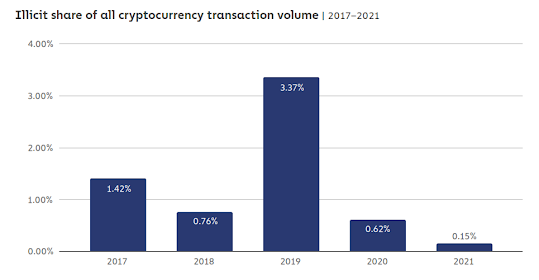
According to Chainalysis, crypto-based crime hit a new all-time high in 2021, with illicit addresses receiving $14 billion over the course of the year, up from $7.8 billion in 2020. However, this represented just 0.15% of total crypto-asset transaction volume, which grew to $15.8 trillion in 2021, up 567% from 2020’s totals. Hence, illicit activity’s share of cryptocurrency transaction volume is actually declining. [Read more]

* To get these updates sent to your inbox, please sign up here. Also, for those interested in intra-day updates and news that didn’t make the Daily Digest cut, please check out my Diigo fintech bookmarks: https://www.diigo.com/user/kiffmeister/Fintech.


Central Bank Digital Currency Workshop, Hosted by the CBDC Think Tank

The CBDC Think Tank (CBDCTT)  is hosting an in-person CBDC Workshop in Washington DC on February 24 exclusively for central bank and finance ministry staff looking to understand and position for CBDC issuance.  [Register here]

Also, in Q2 2022, the CBDCTT will launch the OpenCBDC Sandbox for evaluating, studying and learning from the OpenCBDC Boston Fed and the MIT Digital Currency Institute open source CBDC platform. It will provide easy to use access, with the CBDCTT providing training and all updates. It’s available exclusively to central banks and official institutions. [Read more]